
Auto Air Conditioning Repair in Koreatown: Complete Diagnostic & Service Guide
Los Angeles summers are brutal. When the temperature climbs past 85°F, your car’s air conditioning system isn’t just a luxury—it’s essential for comfort and safety. If you’re a Koreatown driver and your AC has stopped blowing cold air, you’re not alone. Thousands of Angelenos face broken AC systems each year, especially during peak heat seasons.
The good news? Most AC problems are fixable if you catch them early. In this comprehensive guide, we’ll walk you through everything Koreatown drivers need to know about AC repair: warning signs to watch for, how your system works, common problems and their costs, and why professional service matters.
Why Your AC System is Critical in Los Angeles
For Koreatown residents, an air conditioning system isn’t optional. Summer temperatures regularly exceed 90°F, and without a functioning AC, you’re risking your health and your car’s reliability.
Beyond comfort, a broken AC can:
- Create dangerous driving conditions: Heat exhaustion and dehydration impair judgment and reaction time.
- Damage other vehicle systems: Engine overheating can result from AC compressor issues, leading to far costlier repairs.
- Reduce vehicle resale value: A non-functional AC is a red flag for buyers.
- Invite secondary problems: Humidity and moisture invite mold and electrical issues.
That’s why Hyperion Auto Repair recommends getting a free multi-point inspection at the first sign of AC trouble. Our ASE-certified technicians can diagnose issues before they become expensive.
Warning Signs Your AC Needs Repair
Recognizing early warning signs can save you hundreds of dollars. If you notice any of these symptoms, schedule a professional inspection right away.
Weak or No Airflow
Your AC compressor is running, and you hear the fan, but little to no cold air comes out of your vents. This typically indicates a clogged cabin air filter, a failed blower motor, or—more seriously—a compressor issue. Don’t ignore this: weak airflow suggests your system is struggling and may fail completely soon.
Warm Air Instead of Cold
This is the most common AC complaint. Warm air flowing from your vents means your refrigerant is low or your compressor isn’t compressing properly. Possible causes include refrigerant leaks, compressor failure, or a broken expansion valve. This always requires professional diagnosis—there’s no safe DIY fix for AC systems.
Strange Noises from the Engine Compartment
A squealing sound when you turn on the AC indicates a worn serpentine belt or failing compressor bearing. A groaning or grinding noise suggests the compressor clutch is slipping or the compressor is failing internally. These noises are warning signs—continuing to drive can worsen the damage. Don’t delay seeking service.
Bad Odors (Rotten Eggs or Musty Smells)
A musty smell from your vents means bacteria and mold are growing in your evaporator (the component that generates cold air). A rotten egg smell indicates refrigerant contamination or decomposing organic material in the system. Both require professional cleaning and treatment.
System Won’t Turn On
If pressing the AC button does nothing, you have an electrical problem. The issue could be a blown fuse, a failed relay, a broken compressor clutch, or a wiring issue. This requires diagnostic equipment to pinpoint the exact problem.
Ice Buildup on Evaporator or Refrigerant Lines
Frost or ice on AC components means the system is overflowing with refrigerant or the metering device is stuck. This prevents proper heat exchange and can permanently damage components. Stop using the AC and seek immediate service.
How Your Car’s AC System Works
Understanding how your AC system works helps explain why failures happen and why professional repair is essential. Your car’s air conditioning operates using the same principle as your home AC: refrigerant circulates through a closed loop, changing from liquid to gas and back, transferring heat energy.
Here are the five main components you should know about:
The Compressor: Heart of Your AC System
The compressor is the power engine of your AC system. Driven by your engine’s serpentine belt, it pressurizes the refrigerant gas, raising its temperature to roughly 200°F. This hot, pressurized gas then travels to the condenser. The compressor is the most expensive part to replace ($400-$800+) and the most common source of major AC failures.
The Condenser: Removing Heat
The condenser looks like a small radiator mounted in front of your engine bay, behind your grille. Hot pressurized refrigerant gas flows through it. Air blowing across the condenser tubes cools the gas, converting it into a liquid. The heat is expelled into the atmosphere. A dirty or clogged condenser (from road debris and insects) reduces cooling efficiency significantly.
The Expansion Valve: Regulating the Cooling
The expansion valve is a precision device that regulates refrigerant flow based on the temperature setting you select on your dashboard. It meters liquid refrigerant into the evaporator. If the valve clogs or fails, you’ll experience weak cooling or system icing. Replacement typically costs $200-$400.
The Evaporator: Where You Feel the Cold
The evaporator is mounted inside your dashboard, ahead of your cabin. Liquid refrigerant flows through its tubes, evaporating into gas and absorbing heat from the cabin air. Your blower fan pushes this now-cold air into the cabin through your vents. Unfortunately, the evaporator’s enclosed location makes it a breeding ground for mold and bacteria, especially if you don’t use your AC regularly or live in humid areas.
The Accumulator/Receiver: Moisture Control
This small component acts as a temporary storage tank and removes moisture from the refrigerant. Moisture in the AC system causes acid formation, which damages internal components. The accumulator is usually replaced during major AC service to prevent future problems.
Common AC Problems and What Causes Them
Understanding common problems helps you recognize issues early and understand why costs vary so widely.
Low Refrigerant / Refrigerant Leaks (40% of AC Failures)
The most common AC problem is low refrigerant due to leaks. Refrigerant is sealed in a closed loop—if your system is low, it’s leaking somewhere. Leaks commonly occur at:
- Compressor shaft seal (wears out over time)
- Hose connections (vibration and age cause deterioration)
- Evaporator (corrosion from moisture)
- Condenser (road debris damage)
Cost: $150-$300 for recharge and leak repair (if the leak is minor and easily accessible).
Time to repair: 1-2 hours.
Compressor Failure (Most Expensive Repair)
Your compressor can fail for several reasons: dirty or inadequate oil (causing bearing failure), contaminated refrigerant (acidic buildup), lack of use (seals dry out), or normal wear after 100,000+ miles. Compressor failure is the most costly AC repair because the part itself is expensive ($200-$600) and labor-intensive to replace.
Cost: $400-$800 for the part and labor. Some luxury vehicles cost $1,000+.
Time to repair: 2-4 hours.
Electrical Problems (Blown Fuse, Relay, or Clutch)
If your AC won’t turn on despite refrigerant being full, the problem is electrical. Common culprits include:
- Blown AC fuse (10-15 amp fuse, replaceable at a shop)
- Failed relay (controls power to the compressor clutch)
- Broken compressor clutch (electromagnet that engages/disengages the compressor)
- Bad switch (your AC button doesn’t send signal)
Cost: $100-$300 depending on which component failed.
Time to repair: 0.5-2 hours.
Clogged or Stuck Expansion Valve
If your AC is blowing cold but not ice-cold, or if you notice ice on the evaporator or compressor, a stuck expansion valve is likely the culprit. This valve controls the precise amount of refrigerant entering the evaporator. When it sticks, refrigerant flow is restricted or uncontrolled.
Cost: $200-$400.
Time to repair: 1-3 hours.
Mold and Bacterial Growth in Evaporator
The evaporator sits in a dark, damp environment—perfect for mold and bacteria. Over time, organic growth clogs the evaporator or causes odors. This is especially common in Koreatown’s humid climate. Treatment ranges from chemical cleaning to evaporator replacement.
Cost: $150-$400 for cleaning; $500-$1,000 for replacement.
Time to repair: 1-4 hours.
The AC Diagnostic Process
Professional diagnosis is non-negotiable for AC repair. Without proper testing, you risk replacing the wrong part and wasting money. Here’s what a proper diagnostic looks like:
Visual Inspection
The technician first looks for obvious problems: leaking refrigerant (oily residue), damaged hoses, corroded connections, a worn serpentine belt, or damaged condenser fins. Many minor issues are visible on inspection.
Refrigerant Pressure Testing
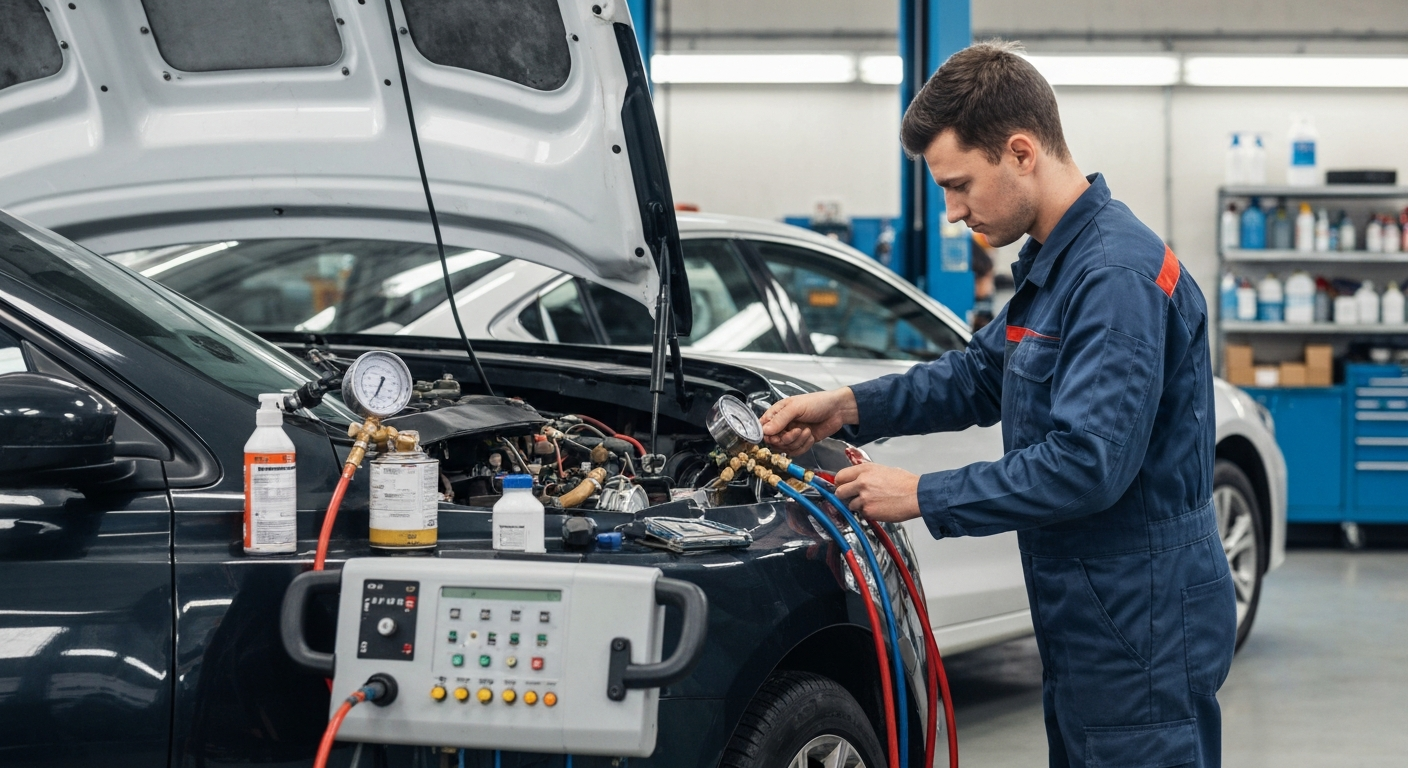
The technician connects high-side and low-side pressure gauges to the AC system. Each gauge measures refrigerant pressure under specific ambient temperatures. Abnormal readings indicate:
- High pressure on both sides: Condenser clogged or refrigerant overcharged
- Low pressure on both sides: Refrigerant leak or compressor not pumping
- High on high-side, low on low-side: Expansion valve stuck or compressor worn
These pressure readings guide the next diagnostic steps.
Electrical System Check
The technician tests whether the compressor clutch engages when the AC is turned on. If the clutch doesn’t engage, a relay, fuse, or switch is faulty. If the clutch engages but the compressor doesn’t pump, the compressor is failing mechanically.
Leak Detection
If pressure testing shows low refrigerant, finding the leak is essential. Technicians use UV dye (added to refrigerant), electronic leak detectors, or soap solutions to pinpoint the exact leak location. This determines repair cost and complexity.
AC Repair vs. Replacement: When to Recharge vs. Replace
Not every AC problem requires a complete system overhaul. Understanding your repair options helps you make cost-effective decisions.
When to Recharge Only ($100-$200)
If your AC is 5+ years old, the system is just low on refrigerant with no leaks detected, recharging is the solution. The technician evacuates the old refrigerant (EPA requirement), inspects the system, adds proper refrigerant charge, and tests the system. This buys you time and restores immediate cooling.
When Component Repair Makes Sense ($200-$800)
If one component has failed but the rest of the system is sound, replacing just that component is efficient. Examples: compressor replacement, condenser replacement, expansion valve replacement. This makes sense for vehicles you plan to keep long-term or newer vehicles with high resale value.
When Full System Replacement is Necessary ($1,000+)
If your vehicle is very old (15+ years), multiple components have failed, or the system is contaminated (acidic refrigerant), a full system replacement might be more cost-effective than piecing repairs together. This is rare but necessary sometimes.
AC Repair Costs in Los Angeles
AC repair costs vary widely based on the problem and your vehicle. Here’s a realistic breakdown:
| Service | Typical Cost Range | Time Required |
|---|---|---|
| AC Recharge (no leak) | $100-$200 | 30 minutes – 1 hour |
| Refrigerant Leak Repair + Recharge | $150-$400 | 1-2 hours |
| Compressor Replacement | $400-$800 | 2-4 hours |
| Condenser Replacement | $300-$600 | 2-3 hours |
| Expansion Valve Replacement | $200-$400 | 1-3 hours |
| Evaporator Replacement | $500-$1,000 | 3-5 hours (dashboard disassembly) |
| Full AC System Service | $300-$600 | 2-3 hours |
Note: These are typical ranges for Los Angeles. Luxury vehicles, imported cars, and older models may cost more. Always get a written estimate before authorizing work.
At Hyperion Auto Repair, we provide transparent quotes with no surprise charges. Our ASE-certified technicians use quality parts backed by warranty.
Why Professional ASE-Certified Service Matters
You might wonder: Can’t I fix this myself? The short answer is no—not safely or legally.
Here’s why professional AC service is non-negotiable:
EPA Regulations: In 1990, the EPA banned the venting of refrigerant (CFCs and HCFCs) into the atmosphere. Handling, recovering, and disposing of refrigerant legally requires federal certification. Violations carry fines up to $37,500. Only certified technicians can legally service AC systems.
ASE Certification: ASE (Automotive Service Excellence) certification proves a technician has passed rigorous exams and has hands-on experience. An ASE-certified AC specialist understands system diagnostics, component interactions, and proper repair procedures. They have access to diagnostic equipment costing $2,000-$5,000+.
Equipment and Tools: Proper AC service requires a recovery/recycling machine ($2,500-$5,000), manifold gauges ($500+), a vacuum pump, and leak detection equipment. Hyperion’s technicians have invested in this equipment to serve Koreatown and surrounding areas professionally.
Warranty Protection: Professional shops back their work with warranties (typically 12 months at Hyperion). DIY repairs have zero warranty, leaving you liable if something goes wrong.
Preventative AC Maintenance
The cheapest AC repair is the one you prevent. Here’s how to keep your system running:
- Run your AC 10 minutes per month in winter: Even during cold months, running your AC for 10 minutes cycles refrigerant and keeps seals lubricated. Without use, seals dry out and leak.
- Get annual AC service: Once yearly, have your system inspected, refrigerant levels checked, and any leaks addressed before they become major. Cost: $50-$100. Benefit: catching problems early.
- Keep your condenser clean: Every 12,000 miles, inspect the front condenser for debris. A gentle rinse with a hose removes bugs and road grime that reduce cooling efficiency.
- Check your serpentine belt: The belt driving your compressor should be inspected regularly. A worn or fraying belt will slip and reduce AC efficiency.
- Run AC before long trips: Running your AC for 5 minutes before a road trip builds up pressure and verifies the system is functioning. Catch problems before they strand you in traffic.
Preventative maintenance costs $50-$150 per year and extends your AC system’s lifespan by 50%+.
Hyperion Auto Repair’s AC Services in Koreatown
At Hyperion, we’ve been serving Koreatown and Los Angeles since 1985. Our commitment to quality and expertise extends to AC repair:
- Free Multi-Point Inspections: We diagnose your AC problem comprehensively—no charge for the evaluation.
- ASE-Certified Technicians: Our team has the expertise and certifications to handle any AC issue safely and legally.
- Warranty on All Repairs: Every AC repair carries a 12-month warranty. We stand behind our work.
- Transparent Pricing: No hidden fees. You get a detailed estimate before we touch your vehicle.
- Same-Day Service: Many AC issues can be diagnosed and repaired the same day. Quick turnaround means less downtime.
- Genuine and Quality Parts: We use OEM or quality aftermarket parts, ensuring reliability and longevity.
Whether you’re in Koreatown, Silver Lake, or anywhere in the LA area, contact Hyperion at (323) 667-3180 to schedule your free AC inspection today.
FAQs About Car AC Repair
Can I refill my AC myself?
No. Federal EPA regulations require certified technicians to handle refrigerant. DIY refills with over-the-counter kits are illegal and dangerous. These kits don’t properly evacuate the system and often overcharge refrigerant, damaging components. Always use a professional.
How long does AC repair take?
Simple recharge: 30 minutes to 1 hour. Leak repair and recharge: 1-2 hours. Compressor replacement: 2-4 hours. Evaporator replacement: 3-5 hours. Hyperion’s team works efficiently without sacrificing quality.
Does my car’s warranty cover AC repair?
If your vehicle is under manufacturer warranty and the AC failed due to a manufacturing defect (not abuse or lack of maintenance), the dealer should cover it. After the warranty expires (typically 3-5 years), AC repair is out-of-pocket. This is why preventative maintenance is important.
How often should my AC be serviced?
At minimum, annually. More frequent checks (every 6 months) are recommended for vehicles in hot climates like Los Angeles, especially for older vehicles.
Does “low on Freon” mean there’s a leak?
Not necessarily. A properly sealed system should never need refrigerant refills. If your system is low, one of two things is true: (1) you have a leak that needs fixing, or (2) the system was undercharged when originally serviced. A professional test will determine which.
Is a noisy AC compressor dangerous?
Yes. A grinding or squealing compressor indicates internal failure. Continuing to drive risks the compressor seizing, potentially damaging the serpentine belt and leaving you stranded. Address it immediately.
Why does my AC smell bad even after repair?
If mold/bacteria grew in your evaporator, a recharge alone won’t eliminate the smell. You need evaporator cleaning or replacement. This is why professional diagnosis is essential—quick fixes don’t address root causes.
The Bottom Line: Don’t Ignore AC Problems
Your car’s air conditioning system is engineered to last the life of your vehicle with proper maintenance. Most failures are preventable. Small problems (low refrigerant) are cheap to fix ($100-$200). Ignored small problems become expensive (compressor replacement, $400-$800+).
If you’re a Koreatown driver experiencing AC trouble, don’t sweat it out. Hyperion Auto Repair offers free multi-point inspections to diagnose your issue. Our ASE-certified technicians will explain your options clearly, provide transparent pricing, and get you back on the road with cold, reliable air conditioning.
Located at 1845 Hyperion Avenue in Los Angeles, we’ve earned the trust of Koreatown families for 40+ years. Call (323) 667-3180 today to schedule your free AC inspection. Summer heat is coming—don’t face it with a broken AC.