Auto Body Shop Near Me in Los Angeles: Complete Guide to Finding Expert Collision Repair Service
After a collision, finding the right auto body shop can feel overwhelming. You’re stressed about your vehicle’s safety, your insurance claim, and how quickly you can get back on the road. The truth is, not all auto body shops are created equal—and the decisions you make in those first hours after an accident will shape your vehicle’s safety, resale value, and long-term reliability.
At Hyperion Auto Repair, we’ve been helping Los Angeles drivers navigate collision repair for over 40 years. In this guide, we’ll show you exactly what to look for in a quality auto body shop, what drives repair costs, your rights as a California vehicle owner, and why Hyperion is the trusted choice for collision repair across the greater Los Angeles area.
What Makes a Full-Service Auto Body Shop Different
When you bring your vehicle to an auto body shop after a collision, you’re entrusting them with more than cosmetic fixes. A true full-service collision center handles everything from the smallest dent to complex structural restoration and safety system recalibration.
Here’s what separates a comprehensive body shop from limited-service alternatives:
- Collision & Structural Repair: Frame straightening and repair, panel replacement, and unibody alignment to factory specifications—critical for crash-safety performance and proper suspension geometry.
- Paintless Dent Repair (PDR): Minor dings and hail damage removal that preserves your vehicle’s original factory paint, saving time and money.
- Paint & Refinishing: Computerized color-matching and manufacturer-approved paint booths that meet or exceed OEM standards for seamless finish and durability.
- Mechanical Repairs: Suspension, steering, and wheel alignment work that’s often knocked out of specification during a collision.
- Glass Repair & Replacement: Windshields are structural components that affect roof strength and airbag geometry—OEM-spec glass is non-negotiable.
- ADAS Recalibration: Modern vehicles have cameras, radar, and sensors that power lane-keeping assist, adaptive cruise control, and collision-warning systems. These must be realigned after any collision.
That last point—ADAS recalibration—is critical and often overlooked. According to safety research from the Insurance Institute for Highway Safety, a forward-facing camera misaligned by just 0.6 degrees can cut automatic emergency braking reaction time nearly in half. A shop that skips this step is returning a car that looks fixed but may not actually be safe.
Key Factors That Drive Collision Repair Costs
Understanding what affects your repair estimate helps you evaluate whether you’re getting fair value for your investment.
1. Damage Severity & Complexity
Not all damage is created equal. A bumper scuff is a fundamentally different repair than frame work, and the labor hours—and costs—reflect that complexity.
- Minor cosmetic damage: Single panel dents or bumper damage typically require 2-5 days and basic paintwork.
- Moderate damage: Panel replacement, paint blending, and mechanical adjustments might require 1-2 weeks.
- Major structural damage: Frame straightening, multi-panel replacement, and ADAS recalibration can take 2-4 weeks or longer.
- Hidden damage discovery: Once panels come off, technicians often find damage not visible from the outside—cracks, dents, or system failures—that require re-approval from your insurance company and additional labor.
2. Technician Certification & Training
A certified technician isn’t just someone with experience—it’s proof of ongoing commitment to training and quality standards.
ASE (National Institute for Automotive Service Excellence) certification requires passing rigorous exams and maintaining continuing education. I-CAR (Inter-Industry Conference on Auto Collision Repair) Gold Class certification is even more selective—only about 10-15% of collision shops nationwide hold this credential. It requires ongoing training, regular audits, and a demonstrated commitment to repair quality and safety.
Shops with ASE and I-CAR certified technicians typically charge more per hour, but you’re paying for expertise, not just time.
3. Parts Selection: OEM vs. Aftermarket
The parts going on your vehicle directly affect its safety, performance, and resale value. You have three main options:
- OEM (Original Equipment Manufacturer): Parts built to your vehicle’s original factory specifications. They guarantee fit, function, and compatibility with all vehicle systems, including ADAS sensors. OEM parts are the costliest option but the safest choice.
- Aftermarket: Third-party manufacturers produce lower-cost alternatives. While some premium aftermarket parts match OEM specs, many don’t meet the precision tolerances required for ADAS cameras and radar sensors. For a modern vehicle with active safety systems, this is a risky gamble.
- Used/Recycled Parts: Salvaged from other vehicles, these work fine for trim, interior panels, and cosmetic components. They’re never appropriate for airbags, seat belts, structural components, or safety sensors.
The bottom line: OEM parts preserve your vehicle’s safety, sensor calibration, factory warranty coverage, and resale value. If a shop offers to save you $500 by using aftermarket fenders on a vehicle with lane-departure warning systems, that discount comes with hidden risk.
4. Equipment & Technical Capabilities
Modern collision repair requires specialized equipment:
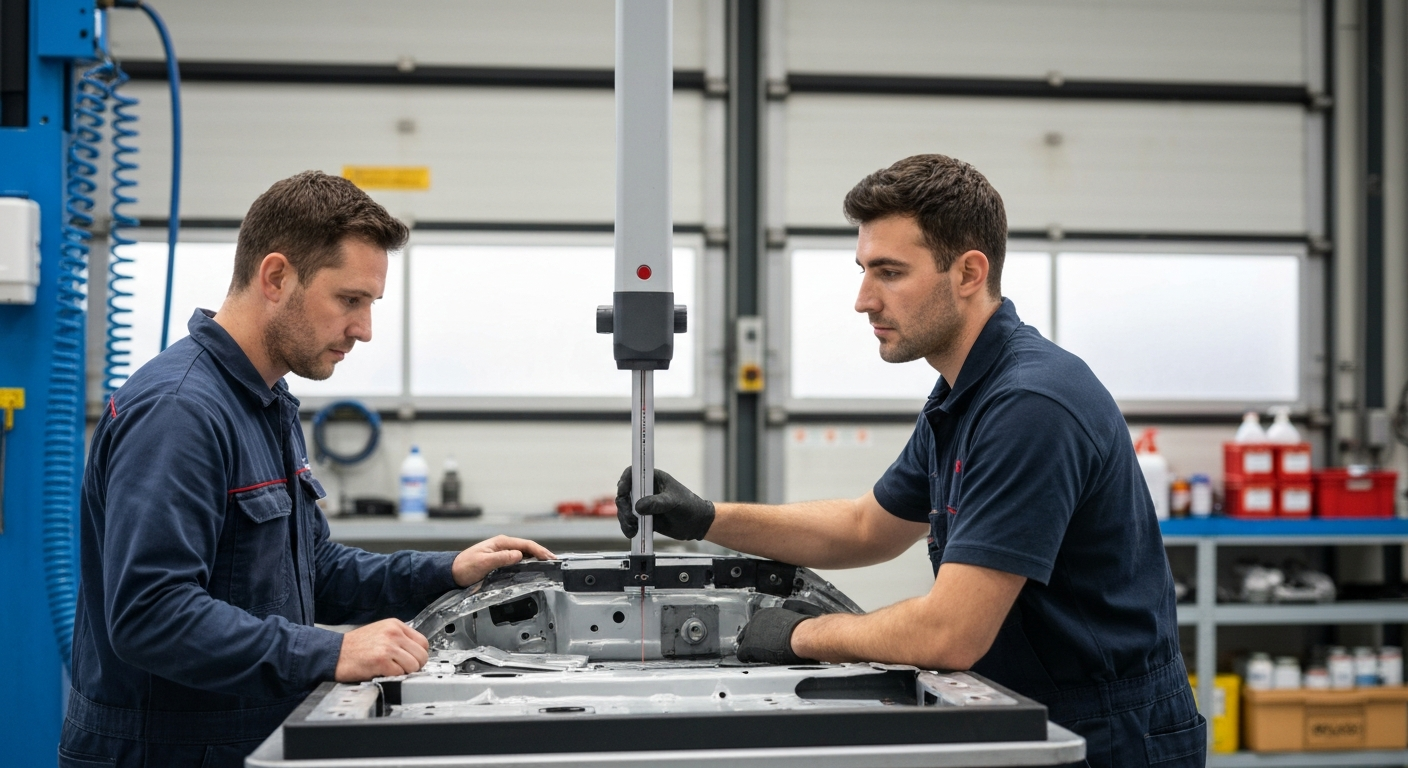
- Laser frame measurement systems: Measure frame geometry with millimeter precision to restore vehicles to exact factory specifications.
- OEM-approved paint booths: Temperature and humidity-controlled environments that match manufacturer standards for color accuracy and finish durability.
- ADAS diagnostic equipment: Camera calibration systems, radar alignment tools, and scan equipment to verify all safety systems function post-repair.
- Pre- and post-repair scanning: Modern vehicles need diagnostic scans before and after repair to catch hidden damage and verify all systems function correctly.
A shop without this equipment can’t deliver OEM-quality repairs, regardless of technician skill.
Understanding the Collision Repair Timeline
One of the most common questions we hear is, “How long will my car be in the shop?” The honest answer is: it depends on several factors beyond the shop’s control.
Minor Damage (2-5 Days)
Dents, scratches, light bumper work, and paintless dent repair typically fall into this category. These repairs might be completed in just a couple of days if no additional damage is discovered.
Moderate Damage (1-2 Weeks)
Panel replacement, paint blending across multiple areas, and basic mechanical work (suspension adjustments, wheel alignment) typically take 1-2 weeks. This assumes straightforward damage with no surprises.
Major Structural Work (2-4+ Weeks)
Frame straightening, multi-panel damage, airbag deployment, and extensive ADAS recalibration require 2-4 weeks or longer. Each of these is labor-intensive and complex.
Several factors can extend any timeline:
- Insurance approval delays: Typically add 3-5 business days as your insurer reviews the estimate.
- OEM parts availability: Specialty components can take a week or more to arrive, especially if they’re imported or in high demand.
- Hidden damage discovery: Once panels come off, technicians might find additional damage requiring re-approval.
At Hyperion Auto Repair, we keep you informed throughout the process and prioritize quality over speed. We complete comprehensive post-repair scanning before returning your vehicle to ensure everything functions as designed.
Your Rights as a California Vehicle Owner
California law gives you powerful protections when choosing an auto body shop. Understanding these rights empowers you to make the best decision for your vehicle.
The California Auto Body Repair Consumer Bill of Rights (California Insurance Code §1874.87) guarantees you the legal right to choose your own collision repair shop. Your insurance company can recommend shops, but they cannot require you to use a specific one. Additionally, anti-steering regulations from 2017 prohibit insurers from making misleading statements designed to push you toward their preferred shops.
Watch out for these common steering tactics:
- “We can’t guarantee the work unless you use our preferred shop.” This is misleading. California law protects your right to choose, and quality shops—independent or chain—should warranty their work regardless of insurance company preferences.
- “Your claim will take longer at that shop.” Often inaccurate. Reputable shops coordinate directly with insurance adjusters and handle claims efficiently.
- “Our preferred shops offer warranties others don’t.” False. Many independent shops offer equal or superior coverage, including lifetime warranties on workmanship.
Choosing your own shop—particularly a quality, independently-operated business—lets you prioritize quality over cost. A good body shop will handle insurance communication for you and advocate for complete, OEM-standard repairs.
How to Choose an Auto Body Shop You Can Trust
With your rights in mind, here’s what to look for when selecting a shop:
1. Check for Proper Certifications
Ask about:
- ASE-certified collision technicians
- I-CAR Gold Class certification (held by only ~10-15% of shops)
- State licensing and business registration
Both certifications require ongoing training and represent a commitment to quality that goes beyond minimum state requirements.
2. Verify Equipment & Technical Capabilities
Tour the shop and ask to see:
- Laser frame measurement systems
- Paint booth specifications and environmental controls
- ADAS diagnostic and calibration equipment
- Diagnostic scanning equipment
If a shop can’t show you advanced equipment, they can’t deliver OEM-quality repairs.
3. Confirm Parts Policy
Ask directly: “Will OEM parts be used on my vehicle?” The answer should be clear and unambiguous. If the shop hedges, uses phrases like “whenever possible,” or offers significant savings for aftermarket parts, that’s a red flag.
Clarify:
- Whether the estimate includes OEM parts or aftermarket
- Warranty on parts and labor
- If they offer a lifetime workmanship warranty (a strong signal of confidence)
4. Review Customer Services
A quality shop goes beyond repairs. Ask about:
- Free estimates: No obligation, itemized quote showing all work and parts.
- Insurance coordination: Does the shop handle insurance communication for you?
- Rental car or shuttle service: Do they offer transportation while your vehicle is repaired?
- Communication: Will they update you regularly on progress?
- Guarantee clarity: Is the warranty in writing with clear terms?
5. Check Reputation & Reviews
Research online reviews, but also ask:
- Is the shop recommended by other businesses (body shops, insurers, dealerships)?
- Do they have a track record of repeat customers?
- Are reviews consistently positive across multiple platforms?
- How long has the shop been in business serving your community?
Why Hyperion Auto Repair is Your Local Expert
Hyperion Auto Repair has been serving Los Angeles drivers for over 40 years. Our reputation is built on technical excellence, honest communication, and a genuine commitment to your vehicle’s safety and your peace of mind.
ASE-Certified Technicians
Our collision specialists hold multiple ASE certifications and commit to continuous training. We invest in our team because your safety depends on their expertise.
Advanced Equipment & Technology
We utilize laser frame measurement systems, OEM-specification paint facilities, and the latest ADAS calibration equipment. Our investment in technology directly translates to better results for your vehicle.
OEM Parts & Warranty
OEM parts are standard on every repair at Hyperion Auto Repair—no exceptions, no aftermarket shortcuts. We back all repair work with a comprehensive warranty on both parts and labor because we stand behind our work.
Customer-First Service
We believe in transparency and customer control:
- Free multi-point inspection: We’ll assess your vehicle’s damage thoroughly—no hidden surprises later.
- Transparent estimates: Our quotes are itemized and clear. You’ll know exactly what work is needed and why.
- Insurance claim coordination: We handle the paperwork and communication with your insurer.
- Same-day assessments available: After many collisions, we can provide a comprehensive evaluation the same day you arrive.
Serving Greater Los Angeles
Located at 1845 Hyperion Avenue in Los Angeles, we serve Silver Lake, East Hollywood, Los Feliz, Atwater Village, and the greater LA area. We’re not a national chain—we’re a family-owned business that knows your community and cares about your long-term satisfaction.
Common Questions About Auto Body Repair
Q: Can I use my insurance’s preferred shop, or should I choose my own?
California law gives you the right to choose any licensed shop. Your insurance company cannot force you to use their preferred shops or penalize you for choosing an independent shop. Make your decision based on quality and reputation, not insurance company preferences.
Q: What’s the actual difference between OEM and aftermarket parts?
OEM parts are manufactured to your vehicle’s exact specifications and are guaranteed to fit and work with all vehicle systems, including ADAS sensors and electronic modules. Aftermarket parts are cheaper but may not meet the precision tolerances modern vehicles require. For safety-critical systems, OEM parts are the only responsible choice.
Q: How long does a typical collision repair really take?
Timelines vary widely based on damage severity and insurance approval delays. Minor cosmetic damage might take 2-5 days, moderate damage 1-2 weeks, and major structural work 2-4 weeks or longer. Many jobs extend beyond these timelines when hidden damage is discovered or parts must be ordered.
Q: What should I do immediately after a collision?
Safety first: ensure everyone is okay and call emergency services if needed. Document the scene with photos. Contact your insurance company to start the claim process. Then take your time choosing a shop—don’t rush this decision. You have the right to select any licensed body shop, so choose one you trust.
Ready to Get Your Vehicle Restored?
If you’ve been in a collision in the Los Angeles area, Hyperion Auto Repair is ready to help. We offer free multi-point inspections, same-day assessments when possible, and transparent communication throughout your repair.
Contact Hyperion Auto Repair today:
- Address: 1845 Hyperion Avenue, Los Angeles, CA 90027
- Phone: (323) 667-3180
- Free Estimate: Call or visit us online for a no-obligation assessment
We’re here to get you back on the road safely.