Auto Body Structural Repair in Los Angeles: Complete Guide to Damage Assessment, Repair Process & Costs
When your car is damaged in a collision, the first thing most drivers notice are the dents and broken lights. But beneath the surface, there may be more serious structural damage that threatens your vehicle’s safety and integrity. Auto body structural repair addresses the underlying frame and safety components of your vehicle—the systems that protect you in a crash and keep your car performing reliably on the road.
At Hyperion Auto Repair in Los Angeles, we understand that structural damage requires specialized expertise and precision equipment. This complete guide will walk you through what structural damage is, how to identify it, the professional repair process, and why choosing certified technicians matters for your vehicle’s safety and value.
What Is Auto Body Structural Repair?
Auto body structural repair is different from cosmetic repair. While cosmetic damage addresses dents, scratches, and paint—the things that affect appearance—structural repair fixes the fundamental components that support your vehicle’s integrity and safety.
Structural damage involves:
- Frame components: The main chassis that supports the entire vehicle
- Unibody structure: On modern vehicles, the body itself forms part of the structural support system
- Pillars and roof structure: Components that provide crush protection in a collision
- Floor pan and subframe: Foundation components for drivetrain and suspension
- Mounting points: Where suspension, engine, and other critical systems attach
The critical difference is that structural damage can be hidden. A vehicle may look nearly normal externally while suffering significant internal frame damage that compromises safety and drivability.
Common Types of Structural Damage in Los Angeles
Structural damage typically results from collision impacts that transfer significant force to the frame and supporting components. The most common types include:
Front-end collision damage: From impacts with other vehicles or obstacles, affecting the frame rails, engine bay structure, and potentially the radiator support, core support, and suspension mounting points.
Rear-end collision damage: Impacts to the back of the vehicle, damaging rear frame sections, rear window frame, trunk floor, and rear suspension attachment points.
Side impact damage: The most serious in terms of structural integrity, side impacts compress the doors, pillars (A-pillar, B-pillar, C-pillar), and floor pan, compromising the vehicle’s “safety cage.”
Roof damage: Often indicates severe collision or rollover, affecting the structural integrity of the entire upper body and requiring specialized repair techniques.
Unibody damage: Modern vehicles use unibody construction where the body itself provides structural support. This damage is complex and requires precision repair.
How to Identify Structural Damage
Not all structural damage is immediately visible. Some warning signs are obvious, while others require professional inspection to detect. If your vehicle has been in any kind of collision—even a “minor” fender bender—have it professionally inspected. Here are the signs to watch for:
Visual warning signs you can notice yourself:
- Doors, hood, or trunk that don’t close properly or sit unevenly
- Uneven gaps between body panels (wider on one side, narrower on the other)
- Paint cracks or peeling at panel joints and welds
- The vehicle pulling to one side while driving straight
- Uneven tire wear (indicating frame misalignment)
- Doors that are difficult to open or close
- Window regulators that bind or don’t work smoothly (indicator of frame twist)
- Visible creases, buckles, or waviness in sheet metal
- Cracks in the windshield or rear glass (from frame stress)
Signs discovered during professional inspection:
- Frame misalignment detected with laser measurement systems (typically within 1/4 inch of factory specs)
- Crushed or kinked frame members
- Damaged or broken welds
- Compromised suspension mounting points
- Damage to safety system sensors (ADAS, airbag sensors)
Professional measurement is the only way to truly know if structural damage exists. Even a 1/4 inch misalignment can affect handling, acceleration, and safety system function.
The Structural Repair Process: Step-by-Step
Professional structural repair at Hyperion Auto Repair follows a proven, systematic process designed to restore your vehicle to factory specifications:
1. Comprehensive damage assessment
We start with a thorough visual inspection and measurements using computerized laser alignment systems. These systems identify exactly what components are out of specification and by how much. The assessment determines whether repair or replacement is more appropriate for each damaged component.
2. Estimate and repair plan development
Based on the assessment, we develop a detailed repair plan that outlines what will be done, the parts and labor required, estimated costs, and timeline. This plan is reviewed with you and shared with your insurance company if applicable. We’re transparent about what’s needed and why.
3. Dismantling and preparation
Affected body panels, trim, interior components, and glass are carefully removed to access the structural damage. These items are labeled and stored safely for reinstallation or replacement.
4. Frame correction
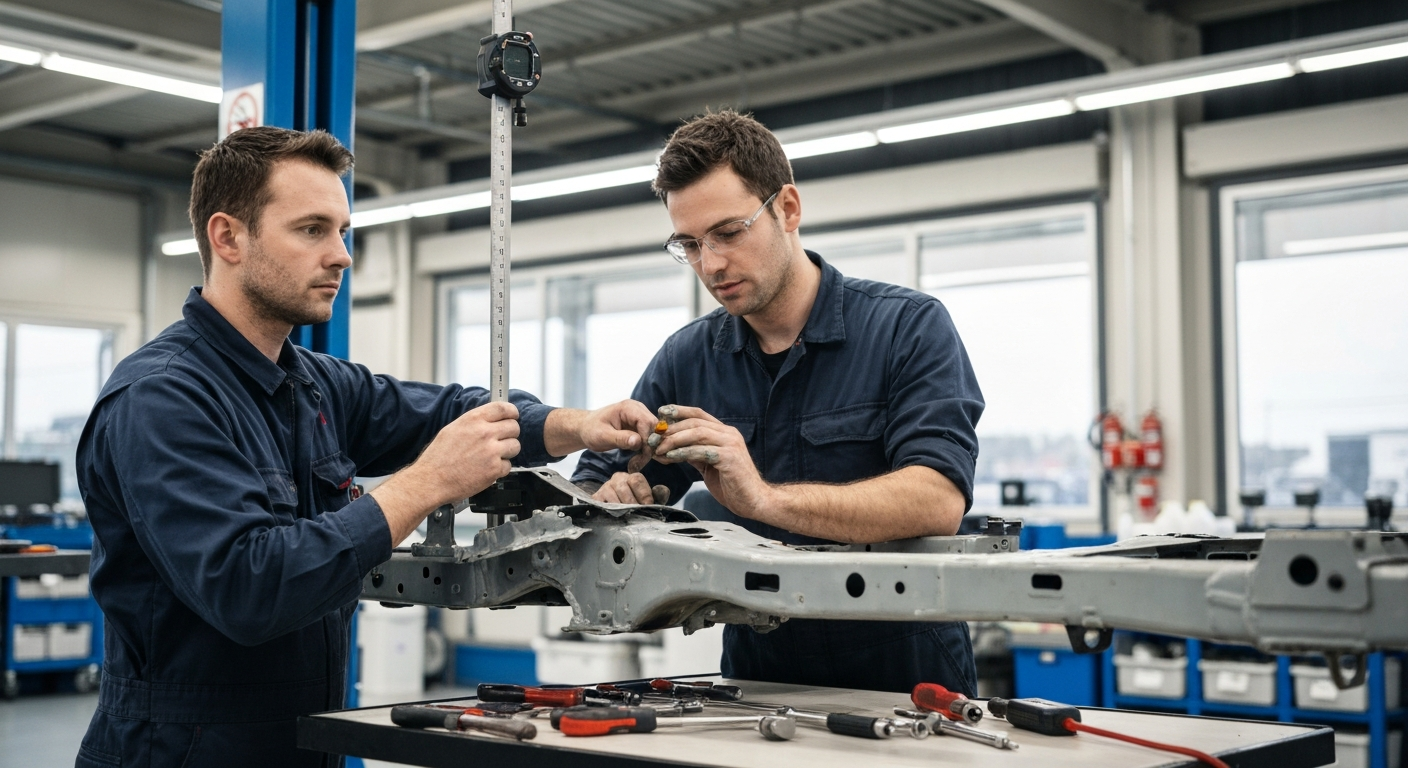
Using specialized frame straightening equipment (hydraulic pullers and computerized measuring systems), we carefully pull the frame back to factory specifications. This is precise, controlled work—forcing the frame too quickly or with too much force can cause additional damage or hidden cracks.
5. Structural component repair or replacement
Damaged components like floor pans, frame rails, pillars, or subframes are either straightened (if possible) or replaced with OEM (original equipment manufacturer) parts. Welding may be required to secure repaired or replaced components.
6. Welding and reinforcement
High-strength structural welds are performed by certified technicians. Modern vehicles often use high-strength steel and aluminum that require specific welding procedures. We follow manufacturer specifications precisely.
7. Safety system recalibration
After structural repair, safety systems must be recalibrated:
– ADAS (Advanced Driver Assistance Systems) cameras and sensors
– Airbag system sensors
– ABS and stability control systems
These systems may not function correctly if sensors are misaligned after frame repair.
8. Quality verification and testing
The repaired structure is re-measured with laser alignment equipment to confirm everything is within factory specs. We test all mechanical and electrical systems to ensure nothing was affected by the repair.
9. Paint and refinishing
If exterior panels were damaged or removed, they’re now repaired or replaced and prepared for paint. Paint matching, primer, base coat, and clear coat are applied following manufacturer guidelines, ensuring a flawless finish that matches your vehicle’s factory appearance.
10. Final inspection and customer walkthrough
Before you pick up your vehicle, we perform a final multi-point inspection and walk you through the completed repairs so you understand everything that was done and why. Your vehicle is now safe, straight, and factory-correct.
Why Professional Service Matters for Structural Repair
Structural repair is not a DIY or quick-fix job. It requires specialized equipment, trained technicians, and adherence to manufacturer specifications. Here’s why professional service is essential:
Specialized equipment: Frame straightening requires hydraulic pullers, measuring systems, and fixture jigs that cost tens of thousands of dollars. Laser measurement systems must be calibrated to within a fraction of an inch. We have this equipment; home mechanics and amateur body shops typically don’t.
ASE-certified expertise: Our technicians hold ASE (Automotive Service Excellence) certifications in structural repair and collision repair. This means they’ve demonstrated knowledge of frame repair procedures, safety systems, and the complex process required to properly restore your vehicle.
Manufacturer specifications: Every vehicle is designed to specific structural tolerances. Repair must meet these specs exactly. We have access to manufacturer repair procedures for your specific vehicle, ensuring we follow the correct process.
Safety compliance: Improper structural repair compromises your safety in a future accident. Your vehicle’s ability to absorb crash energy and protect you depends on proper frame alignment and structural integrity. Professionals ensure this is done right.
Insurance coordination: We work directly with insurance companies, handling documentation, providing detailed estimates, and coordinating the claims process. This takes stress off you during an already difficult situation.
Warranty protection: Professional repairs come with a warranty. If any issue arises from the repair work, we stand behind it. Improper repairs done elsewhere often have no recourse if problems develop.
Structural Repair vs. Cosmetic Repair: What’s the Difference?
It’s important to understand the difference between these two types of damage, as they require different expertise and represent different levels of severity:
Cosmetic repair: Addresses dents, dings, paint scratches, and broken trim. These repairs affect appearance but not the vehicle’s structural integrity or safety. Examples include: a dent in a door panel, a cracked bumper cover, or a small paint scratch. These can often be repaired quickly and inexpensively.
Structural repair: Addresses damage to the frame, pillars, floor pan, and safety components. These repairs are critical for vehicle safety and performance. Even seemingly small structural misalignment (1/4 inch) can affect handling, suspension performance, and safety system function.
Why you can’t ignore structural damage:
- Safety is compromised in future collisions; the vehicle won’t protect you properly
- Suspension and steering may not perform correctly, affecting handling
- Tire wear becomes uneven, shortening tire life and affecting stability
- Doors and windows may bind or not seal properly, affecting weather-tightness
- Resale value is significantly reduced if structural damage isn’t professionally repaired
- Insurance may deny future claims if undisclosed structural damage is present
Many people make the mistake of addressing only cosmetic damage and ignoring underlying structural issues. This is dangerous and often works against you financially—the vehicle becomes worth less, and safety is compromised.
Auto Body Structural Repair Costs in Los Angeles
The cost of structural repair varies widely based on the extent of damage, the vehicle, and the specific components affected. Here’s what you can expect:
Typical cost ranges:
– Minor structural damage: $500–$2,000
– Moderate structural damage: $2,000–$7,000
– Severe structural damage: $7,000–$20,000+
Factors that affect the cost:
- Severity and extent of damage: How many frame members are damaged and by how much
- Materials involved: Steel, aluminum, or carbon fiber require different techniques and tools
- Parts required: OEM replacement parts may need to be ordered, adding cost and time
- Labor hours: Complex repairs take longer; more hours mean higher labor costs
- Welding and reinforcement: Additional welding work increases costs
- Safety system recalibration: Modern vehicles require sensor calibration, an additional service cost
- Paint and refinishing: If exterior panels are affected, paint work adds to the total cost
Most structural damage from collisions is covered by insurance. We handle the insurance coordination so you understand your coverage and out-of-pocket costs before work begins.
How Long Does Structural Repair Take?
The timeline for structural repair depends on the complexity of the damage:
Minor frame pull: 1–3 days. Simple frame straightening without part replacement or welding.
Moderate damage: 1–2 weeks. Includes frame straightening, some component replacement, and possible welding work.
Severe structural damage: 2–4+ weeks. May require major part replacement, extensive welding, multiple rounds of measurement and correction, and comprehensive safety system recalibration.
Factors that can extend the timeline:
- Parts availability—if OEM parts must be ordered, this adds days or weeks
- Insurance authorization delays—insurance companies sometimes delay approvals
- Complexity of the vehicle—luxury or performance vehicles may require specialized procedures
- Hidden damage discovered during repair—sometimes additional damage is found once work begins
We provide a realistic timeline estimate upfront and keep you updated throughout the repair process.
Insurance & Structural Repair Claims
Most collision insurance policies cover structural damage from accidents. Here’s what you need to know:
What insurance typically covers: Structural damage from accidents is generally covered under the collision portion of your insurance. This includes frame repair, component replacement, welding, and recalibration of safety systems.
What may not be covered: Damage from wear and tear, poor maintenance, or pre-existing conditions typically isn’t covered. If you had previous undisclosed structural damage, a new accident may complicate your claim.
The claims process:
- Report the accident to your insurance company
- Insurance assigns an adjuster to inspect the vehicle
- We provide the insurance company with our detailed damage assessment and repair estimate
- Insurance either approves the estimate or negotiates repairs
- Once approved, we proceed with the repair
- We coordinate with insurance about parts availability and timeline changes
- You pay your deductible; insurance covers the rest (usually)
At Hyperion Auto Repair, we handle this process for you, managing communication with your insurance company and keeping you informed every step of the way. We work with all major insurers and can help explain coverage questions.
Why Choose Hyperion Auto Repair for Structural Repair?
When your vehicle needs structural repair, you want a shop you can trust to do the job right. Here’s why Hyperion Auto Repair is your best choice in Los Angeles:
ASE-certified technicians: Our team includes ASE-certified professionals with extensive experience in structural and collision repair. We’re trained in the latest techniques and have hands-on expertise with all major vehicle types.
Advanced equipment: We have the specialized equipment necessary for precision frame repair, including computerized laser alignment systems that measure to within a fraction of an inch. Our facility meets all industry standards.
Free multi-point inspections: Not sure if you have structural damage? We offer free multi-point inspections to assess your vehicle’s condition thoroughly. There’s no obligation—we just want to help you understand what your vehicle needs.
Insurance coordination: We handle all the paperwork and communication with your insurance company, making the process stress-free. We work with all major insurers and help you navigate coverage questions.
Warranty on all work: We stand behind our repairs. Every job includes a comprehensive warranty, so you have confidence in the work we’ve done.
Professional service you can trust: Family-owned since 1985, Hyperion Auto Repair has earned a reputation as Los Angeles’s most trusted auto repair shop. Our commitment to quality, honesty, and customer care is reflected in every job we do.
Related services: If your collision also resulted in other damage, we provide comprehensive services. Learn more about collision auto repair, frame straightening, and professional frame repair services.
Contact Hyperion Auto Repair Today
If your vehicle needs structural repair or you’re not sure what damage you have, contact Hyperion Auto Repair today:
Address: 1845 Hyperion Avenue, Los Angeles, CA 90027
Phone: (323) 667-3180
Free multi-point inspection available
Whether you’re dealing with minor frame misalignment or severe structural damage, we’re here to restore your vehicle to factory specifications and get you back on the road safely. Contact us today for a free inspection and estimate. Your vehicle—and your safety—deserve professional care.