
Why Your Car AC Isn’t Cold: 7 Common Causes and Diagnostic Guide
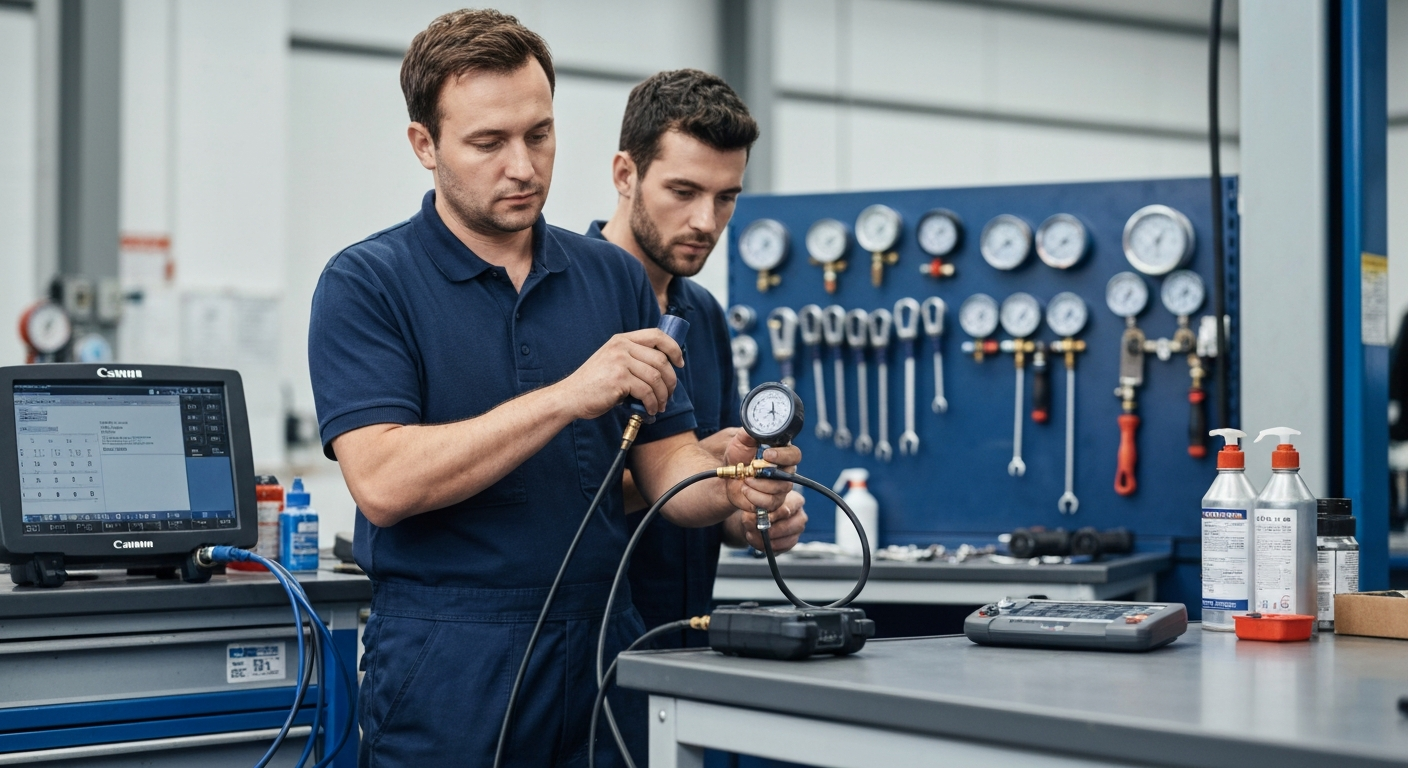
There’s nothing worse than summer heat in Los Angeles when your car’s air conditioning stops working properly. A car AC that blows warm air instead of cold can ruin your driving experience and dangerously raise your vehicle’s interior temperature. When the mercury climbs above 95°F outside, a functioning AC system isn’t a luxury—it’s essential for your safety and comfort.
At Hyperion Auto Repair, we diagnose AC problems every day. Most drivers don’t realize their AC system is complex with multiple components that can fail independently. Understanding the common causes helps you get the right repair faster and avoid costly mistakes. In this guide, we’ll explore the seven most common reasons your car’s AC might not be blowing cold air and what you can do about it.
1. Low or Leaking Refrigerant
The most common AC problem is low refrigerant—and it’s usually caused by a leak. Your car’s AC is a completely sealed system. Refrigerant should never escape or need “topping off” like engine oil. When you notice your AC blowing warm air or cooling less effectively than before, low refrigerant is often the culprit.
How it happens: Refrigerant leaks develop through failed hose connections, worn seals on the compressor, or cracks in aluminum components. These leaks don’t repair themselves, and they worsen over time.
Why it matters: A refrigerant leak means your system is losing its ability to absorb heat. The less refrigerant present, the less cooling you get. Eventually, the pressure drops so low that the compressor won’t engage at all.
Professional diagnosis: Technicians use specialized leak detection equipment to find even tiny leaks invisible to the naked eye. This might involve fluorescent dye injected into the system or electronic leak detectors that pinpoint the exact location of escaping refrigerant.
Learn more about AC recharge costs and what’s involved in restoring your system’s refrigerant levels.
2. Failed AC Compressor
The compressor is the heart of your AC system. Think of it like the engine of air conditioning: it takes low-pressure gaseous refrigerant and pressurizes it so it can circulate through your system and cool the air. When the compressor fails, you get warm air because the refrigerant can’t be pressurized and moved through the system effectively.
Signs of compressor failure:
- AC produces no cold air at all
- Grinding or squealing noises from under the hood
- AC compressor clutch doesn’t engage (no clicking sound)
- AC system cycles on and off rapidly
- Visible oil leaks near the compressor
Why replacement is necessary: Unlike some AC components, a worn compressor can’t be effectively repaired. Once internal seals fail, the compressor is done. Replacement is one of the most expensive AC repairs because the compressor is a complex, labor-intensive component to replace.
Compressor failure typically costs $1,500-$3,500+ depending on your vehicle, and labor can take 2-4 hours. Read our guide on AC repair costs in Los Angeles to understand what you might expect.
3. Defective Condenser or Condenser Fan
The condenser’s job is to convert high-pressure refrigerant gas into liquid—a process that removes heat from the refrigerant. The condenser fan helps move air through the condenser coils to assist this heat removal. If either the condenser is clogged or the fan isn’t working, heat removal stops and you get warm air coming from your vents.
Common condenser problems:
- Clogged condenser: Dust, dirt, dead leaves, and road debris accumulate on the condenser fins, blocking airflow. This is especially common in Los Angeles with its dusty air and traffic pollution.
- Damaged condenser: Impact damage from debris on the highway can puncture condenser tubes, causing refrigerant leaks and cooling loss.
- Failed condenser fan: The electric fan should spin when AC is running. If it doesn’t, heat can’t escape and cooling suffers.
- Fan motor or clutch failure: The mechanical or electrical connection that engages the fan can fail, leaving it stationary.
Quick diagnostic tip: While the AC is running, open your hood and look at the fan in front of your radiator. It should be spinning. If it’s stationary, you’ve found the problem. If it’s spinning but AC is still warm, your condenser likely needs cleaning or replacement.
4. Dirty or Clogged Cabin Air Filter
Here’s some good news: if your AC system is actually producing cold air but airflow is weak, the problem might be as simple as a dirty cabin air filter. Your car has a filter that cleans incoming air before it reaches your cabin, separate from your engine air filter.
Why filters matter: A clogged cabin air filter doesn’t just reduce airflow—it makes your AC work harder, reducing cooling efficiency by 30-50%. It also forces your AC compressor to work longer to maintain the same temperature, which uses more fuel and accelerates wear.
Good news: Cabin air filter replacement is easy and inexpensive—typically $50-$150 depending on your vehicle. It’s one of the most cost-effective AC “repairs” you can make.
How to check: Most cabin filters are located behind your glove compartment. Pop it open, remove the filter, and hold it up to light. If you can barely see through it, you’ve found your problem. Filters should typically be replaced every 15,000-30,000 miles, depending on your driving environment.
5. Broken AC Capacitor
The capacitor is an electrical component that stores energy and helps start the AC compressor motor. When a capacitor fails, the compressor won’t engage—meaning your AC system produces no cold air at all.
Why this is actually good news: Unlike compressor failure, a capacitor is inexpensive and quick to replace. Typical cost is $200-$400, compared to $1,500+ for a compressor. If your AC simply won’t turn on and there’s no humming sound, a bad capacitor is a likely culprit.
Signs of capacitor failure:
- AC won’t turn on at all
- No sound or clicking when AC button is pressed
- Humming sound but compressor won’t engage
- AC works intermittently
Diagnostic test: Listen carefully under the hood when you turn on the AC. You should hear a distinct click or engagement sound as the compressor clutch engages. No sound at all suggests electrical failure, possibly a bad capacitor.
6. Electrical Problems or Failed Sensors
Modern vehicles rely on multiple electrical sensors and circuits to operate the AC system. A failure in any of these can prevent proper AC operation:
- Low-pressure sensor: Shuts down the compressor if refrigerant pressure drops too low, preventing damage. A faulty sensor might shut down your AC unnecessarily.
- Compressor clutch relay: Controls power to the compressor clutch. A failed relay prevents compressor engagement.
- AC switch: The button or dial you press to turn on AC might have failed or lost electrical connection.
- Wiring and connections: Corroded or broken wires can interrupt the electrical signal needed to run the AC system.
- Engine control module (ECM) codes: Fault codes in your vehicle’s computer can disable AC as a protective measure when other engine systems fail.
Professional diagnosis needed: Electrical problems require specialized diagnostic equipment. A technician will read diagnostic trouble codes, test voltages and continuity with a multimeter, and inspect connections for corrosion or damage.
7. Frozen Evaporator Coil
Ironically, an AC system can actually freeze up internally even while blowing warm air. The evaporator coil sits inside your cabin and absorbs heat from the air. If the coil freezes, it can’t absorb heat properly and you might get warm or weak cold air.
Why coils freeze:
- System contamination: Water or debris in the refrigerant causes ice formation on coil surfaces.
- Restricted airflow: A dirty cabin filter or blocked evaporator reduces airflow, causing coil temperature to drop below freezing.
- Low refrigerant: Paradoxically, low refrigerant can also cause freezing in some cases when pressure drops too low.
- Thermostat malfunction: A faulty temperature control might not shut off the AC when it should, allowing ice accumulation.
Visual inspection: If you can safely access the AC lines under your hood or at the firewall, look for visible ice buildup. Ice on the AC hoses is a clear sign your evaporator has frozen over.
Professional cleaning required: Fixing a frozen evaporator requires flushing the system with specialized equipment to remove contaminants, then proper evacuation and recharge. This isn’t a DIY job.
How to Diagnose Your AC Problem at Home
Before calling a mechanic, you can perform basic diagnostics to narrow down the problem. These simple checks take just a few minutes and might save you time at the shop.
Step 1: Check Airflow Quality
Turn on your AC to the coldest setting. Feel the air coming from all vents. Is it cold or warm? Is the airflow strong or weak?
- Cold airflow (strong): Your system is working! You probably just need a cabin filter replacement or a minor charge. Consider yourself lucky.
- Cold airflow (weak): Likely a dirty cabin filter, electrical/compressor issue, or partial refrigerant loss.
- Warm or lukewarm airflow (any strength): Suggests low refrigerant, failed compressor, or sensor problem. Professional diagnosis needed.
- No airflow: Could be electrical, failed blower motor, or compressor not engaging.
Step 2: Listen for Compressor Engagement
Pop your hood and have someone turn the AC on while you listen carefully. You should hear a distinct click or mechanical engagement sound near the engine. This is the compressor clutch engaging.
- You hear clicking: Compressor is engaging, so electrical side is working. Problem is likely refrigerant, capacitor, or compressor malfunction.
- You hear nothing: No engagement suggests electrical failure, blown fuse, bad capacitor, or faulty relay.
- You hear humming but no click: Electrical signal is reaching the compressor but the clutch isn’t engaging—possible bad capacitor or worn clutch.
Step 3: Check the Condenser Fan
With the AC running, look at the fan mounted in front of your radiator (behind the grille). It should be visibly spinning. This fan helps cool the condenser coils.
- Fan is spinning: Good sign. Continue diagnosis with other steps.
- Fan is stationary: You’ve found a problem. The fan motor or its electrical connection has failed.
- Fan spins only sometimes: Suggests a faulty fan clutch or temperature switch.
Step 4: Smell for Burnt Odors
A burnt smell coming from your AC vents or under the hood is a warning sign. This indicates electrical shorts, compressor failure, or burning wire insulation—all serious problems that need immediate professional attention.
If you smell anything burning, stop using your AC immediately and have it inspected. Continue driving to a mechanic, but don’t run the AC.
Why Professional Diagnosis Matters
AC systems are deceptively complex. The same symptom (warm air) can be caused by seven different problems. Guessing wrong means paying for an unnecessary repair or doing a temporary fix that fails a week later.
Professional technicians use equipment you don’t have:
- Dual refrigerant gauges: Measure high and low side pressure precisely, revealing refrigerant level and system blockages.
- Leak detection equipment: Ultraviolet dye and electronic detectors find leaks invisible to human eyes.
- System flushing equipment: Removes contaminants that damage compressors.
- Diagnostic scan tools: Read fault codes and sensor data from your vehicle’s computer.
- Thermal cameras: Detect temperature differences indicating problems.
- Evacuation and recharge machines: Properly remove old refrigerant and install new refrigerant according to EPA regulations.
At Hyperion Auto Repair, we offer free AC diagnostic inspections so you know exactly what you need before any work begins. No obligation, no surprise bills.
When to Repair vs. Replace Your AC System
If you have an older vehicle with a failed AC system, you face a decision: repair or replace?
Use the 50% Rule: If repair costs exceed 50% of replacement cost, replace instead. For example:
- Compressor replacement: $2,500
- System replacement cost: $4,000-$5,000
- Since $2,500 = 50% of replacement cost, either option makes financial sense.
Other factors to consider:
- Vehicle age: If your car is 12-15+ years old, replacing the AC system makes sense. A compressor replacement might just buy 1-2 years before the next failure.
- Repair history: Multiple AC repairs in the past 2 years suggest the system is declining. Replacement offers better long-term reliability.
- Efficiency gains: Modern AC systems are 15-20% more efficient than units from 10+ years ago, lowering fuel consumption.
- Refrigerant type: Older vehicles using R-22 refrigerant face rising costs as it’s phased out. Replacement with R-410A avoids future price increases.
Get Your AC Fixed Today
Don’t suffer through another hot Los Angeles summer without functioning air conditioning. Hyperion Auto Repair has been serving our community since 1985 with honest, transparent service.
When you bring your car to us, you get:
- Free diagnostic inspection: We’ll identify the exact problem at no charge.
- ASE-certified technicians: Our team holds the gold-standard automotive certification.
- Transparent pricing: Detailed estimate before any work begins. No hidden fees or surprises.
- Warranty on all repairs: We stand behind our work. Every AC repair comes with our warranty.
- Same-day service available: We understand you need your AC working ASAP, especially in LA heat.
- Professional Auto Care You Can Trust
Contact Hyperion Auto Repair today:
- Phone: (323) 667-3180
- Address: 1845 Hyperion Avenue, Los Angeles, CA 90027
- Hours: Call for current service hours and availability
Let our ASE-certified technicians get your AC running cold again. We’re your neighborhood shop that’s been trusted by Los Angeles families for 40 years.