
Auto AC Repair in Los Angeles: Complete Guide to Costs, Diagnosis & Professional Solutions
During Los Angeles summers, when temperatures soar above 95°F, a functioning air conditioning system isn’t a luxury—it’s essential for your safety and comfort. When your car’s AC breaks down, it can turn a simple drive into an uncomfortable, even dangerous situation. Whether you’re stuck in traffic on the 101 or parked in the blazing sun, a broken AC system demands professional attention. That’s where air conditioning repair in Los Angeles becomes critical.
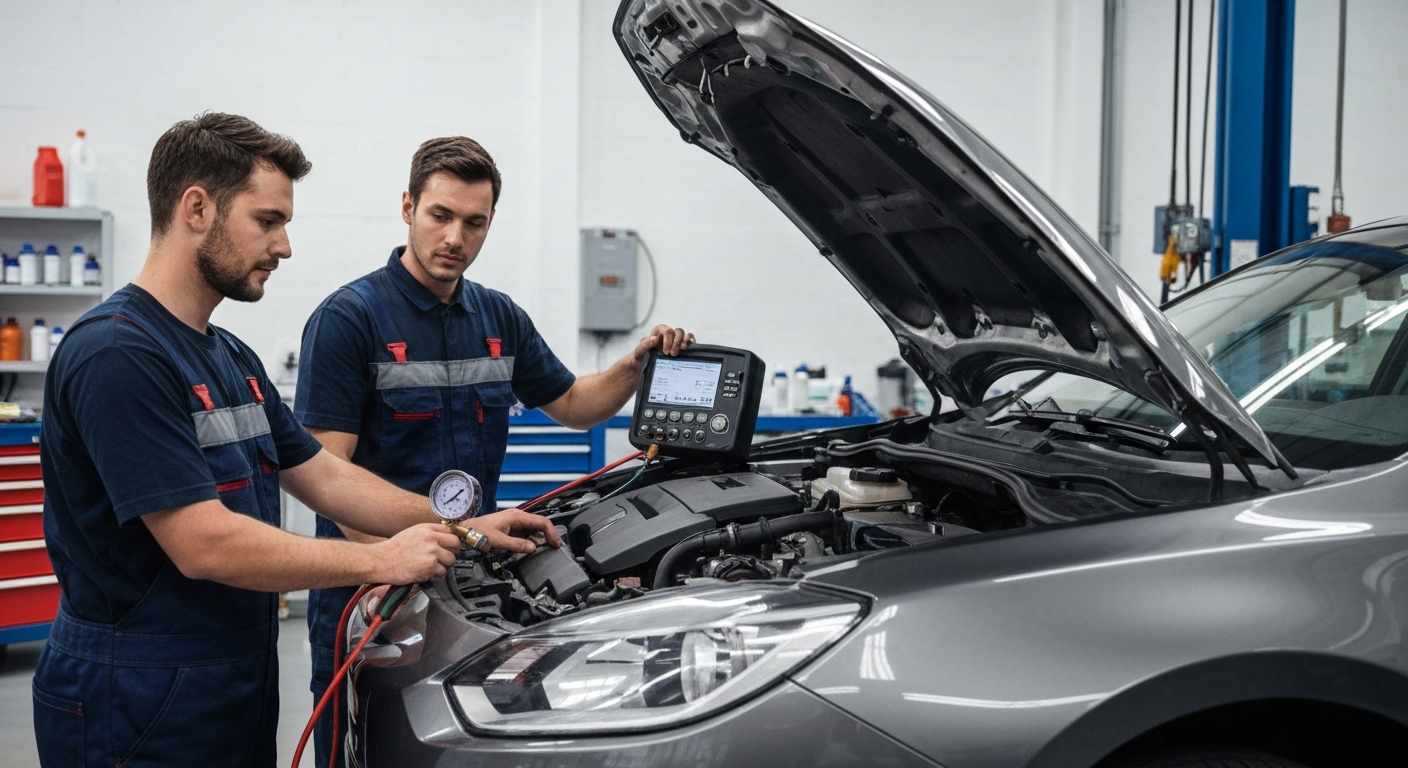
At Hyperion Auto Repair, our ASE-certified technicians have been diagnosing and fixing AC systems for families and businesses throughout Los Angeles since 1985. We understand the urgency of a broken AC, and we’re equipped with modern diagnostic equipment to pinpoint the exact problem and get you back on the road fast. This comprehensive guide covers everything you need to know about auto AC repair costs, warning signs, and why professional service matters for your vehicle and your wallet.
7 Warning Signs Your Car’s AC Needs Professional Repair
Recognizing AC problems early can save you thousands in repair costs. Here are the most common warning signs that your vehicle’s air conditioning system needs professional attention:
1. AC Not Blowing Cold Air (Most Common Problem)
This is the #1 reason drivers seek AC repair. If your AC is running but the air coming from the vents is warm or only slightly cool, several issues could be responsible. The most common culprit is low refrigerant, which can result from a slow leak in the system. Refrigerant doesn’t “use up” like fuel—it circulates continuously. If your AC is low on refrigerant, there’s always an underlying leak that needs to be found and fixed.
2. Weak Airflow from Vents
If cold air is coming out but the airflow is weak, the problem might be a clogged cabin air filter, a blocked condenser, or a failing compressor clutch. A cabin air filter typically needs replacement every 15,000-30,000 miles. A simple filter replacement costs $30-$75 and can restore proper airflow.
3. Strange Odors (Rotten Eggs, Musty, or Burning Smell)
A rotten egg or musty smell from your AC vents usually indicates mold or bacteria growing in the evaporator, typically behind the dashboard. This is especially common if you don’t use your AC regularly or live in a humid climate. A burning smell could indicate an electrical problem in the compressor or a refrigerant issue. Both require immediate professional inspection.
4. Unusual Noises (Squealing, Grinding, or Hissing)
Squealing usually indicates a worn serpentine belt that drives the AC compressor. A grinding noise often signals a failing compressor that needs replacement. Hissing sounds might indicate a refrigerant leak. Any unusual noise means something is wrong and should be diagnosed by a technician.
5. Compressor Clutch Not Engaging
When you turn on the AC, you should hear the compressor clutch engage (a clicking sound). If the engine is running but there’s no sound and the AC isn’t cooling, the compressor isn’t engaging properly. This could be due to electrical issues, a faulty clutch, or low refrigerant preventing the system from activating.
6. Leaking Fluid Under Your Car
If you notice clear, oily fluid dripping under your car near the engine compartment, you likely have a refrigerant leak. Refrigerant (R134a or R1234yf depending on your vehicle’s year) is under high pressure in sealed lines. Any leak means your system cannot maintain proper pressure and cooling.
7. AC Only Works Intermittently
If your AC works fine one day but not the next, or blows cold initially then warms up, you likely have a refrigerant leak that causes pressure fluctuations. Intermittent operation is a red flag that the problem is getting worse and needs professional diagnosis before it becomes a complete failure.
Auto AC Repair Costs in Los Angeles: What to Expect
AC repair costs vary widely depending on what’s wrong. Understanding the price breakdown helps you budget and recognize fair pricing when you get a quote.
AC Recharge: $150-$300
The simplest and most affordable AC service is a recharge (also called a “top-up”). This involves adding refrigerant to bring the system back to factory specifications. However, here’s the critical point: if your system is low on refrigerant, there’s a leak. A recharge alone is a temporary fix. Check out our detailed AC recharge cost guide to understand when recharging is appropriate vs. when a repair is necessary.
Refrigerant Leak Repair: $200-$600
Finding and fixing a refrigerant leak is more involved than a simple recharge. Our technicians use specialized equipment to locate the leak (common sites include hose connections, the condenser, and the evaporator). Once located, the leaking component is repaired or replaced, and the system is refilled with refrigerant and lubricant. This prevents the leak from returning and the problem from recurring.
Condenser Replacement: $300-$1,000
The condenser cools hot refrigerant gas into a liquid. It’s mounted in front of your radiator and can be damaged by debris, accidents, or corrosion. Replacement is labor-intensive but necessary if the condenser is leaking or failing. Parts cost $200-$600; labor adds $100-$400.
Compressor Replacement: $400-$1,200
The compressor is the heart of your AC system—it pressurizes refrigerant and circulates it through the system. A failing compressor is one of the most expensive repairs, costing $400-$800 for the part alone, plus $150-$400 in labor. However, a new compressor can last 10+ years if the system is properly maintained. When a compressor fails, it often means metal particles contaminate the refrigerant, so the entire system should be flushed and oil replaced.
Evaporator Replacement: $800-$1,500
The evaporator sits behind your dashboard and is where refrigerant absorbs heat from cabin air. A failing or leaking evaporator requires dashboard removal—extensive labor ($500-$800 alone). This is one of the most labor-intensive AC repairs, making it potentially the most expensive single repair.
Expansion Valve or Accumulator Replacement: $200-$500
These components regulate refrigerant flow. Replacement is less common than compressor or condenser work but becomes necessary if they’re leaking or clogged.
Full AC System Replacement: $1,500-$3,000+
In rare cases (severe damage, multiple failed components, or very old systems), replacing the entire AC system is more cost-effective than piecemeal repairs. This is typically only recommended for older vehicles where the compressor and condenser have both failed.
Why Labor Costs Matter
AC repair labor in Los Angeles typically ranges $100-$200/hour. ASE-certified technicians command higher rates because they have the training, tools, and credentials to diagnose complex issues accurately. At Hyperion Auto Repair, we charge fair rates for expert service—you’re paying for precision diagnosis that avoids unnecessary repairs.
How Your Car’s AC System Works (Technical Overview)
Understanding your AC system helps you recognize when something’s wrong and why professional repair matters.
The Main Components
Compressor: Driven by your engine’s serpentine belt, the compressor compresses low-pressure refrigerant gas into high-pressure gas, heating it in the process.
Condenser: Located in front of the radiator, the condenser uses airflow to cool the hot, high-pressure refrigerant gas, condensing it into a liquid.
Expansion Valve: This precision device restricts refrigerant flow, causing a pressure and temperature drop as refrigerant enters the evaporator.
Evaporator: Located behind your dashboard, the evaporator receives low-pressure, low-temperature liquid refrigerant. Warm cabin air passes over the evaporator coils, and the refrigerant absorbs heat, cooling the air you feel from your vents.
Accumulator/Receiver-Drier: This component removes moisture and filters the refrigerant to protect the system from contamination. It’s essential for system reliability.
How Refrigerant Circulates
Refrigerant flows in a continuous cycle: compression → condensing → expansion → evaporation → back to compression. This cycle repeats continuously while your AC is on. The refrigerant carries heat away from your cabin and releases it outside. If any component fails or the system develops a leak, the cycle breaks down and cooling stops.
Why Professional Diagnostics Matter
Modern AC systems are sealed, high-pressure systems requiring specialized equipment to diagnose. Our technicians use electronic diagnostic scanners, pressure gauges, leak detection equipment, and thermal imaging to pinpoint problems accurately. Guessing at what’s wrong wastes money on unnecessary repairs.
Modern Refrigerants
Older vehicles (pre-1994) use R12 refrigerant, which has been phased out due to environmental concerns. Most vehicles built 1994-2020 use R134a. Starting in 2021, manufacturers transitioned to R1234yf, which is more environmentally friendly. Using the correct refrigerant for your vehicle is essential—mixing types damages the system. This is another reason professional service is critical.
AC Repair vs. AC Recharge: When to Choose Each Option
One of the most misunderstood aspects of AC service is the difference between a repair and a recharge.
When a Recharge Works
If your AC system is functioning properly but has lost some refrigerant due to normal, slow leakage over years (not all systems leak, but some do), a simple recharge may restore cooling. This is rare—most systems that need refrigerant have a problem.
The Leak Problem
If you need an AC recharge, your system has lost refrigerant. In most cases, this means there’s a leak. A recharge temporarily restores cooling, but within weeks or months, you’ll lose refrigerant again and need another recharge. This becomes expensive quickly. For example, five recharges at $200 each = $1,000, which covers most AC repairs outright.
Long-Term Cost Comparison
Scenario 1 (Recharge Only): $200 recharge now, another $200 in 3 months, another $200 in 6 months = $600 over one year, and the problem persists.
Scenario 2 (Proper Repair): $350 leak detection and repair, $150 recharge = $500 total. The problem is solved permanently.
Professional repair is almost always cheaper than repeated recharges.
Hyperion’s Advantage: Free Multi-Point Inspection
At Hyperion Auto Repair, we offer a free multi-point inspection that includes AC system evaluation. We’ll determine whether your AC needs a simple recharge, a leak repair, or a component replacement. We never recommend unnecessary work—our goal is to fix the problem right the first time.
Why Choose Hyperion Auto Repair for Your AC Service
When your car’s AC fails during a Los Angeles summer, you need a shop you can trust. Here’s what sets Hyperion apart:
ASE-Certified Technicians
Our technicians hold ASE (Automotive Service Excellence) certifications, recognized throughout the industry as the gold standard for automotive expertise. ASE certification requires passing rigorous exams and maintaining continuous education. You’re getting expert diagnosis, not guesswork.
Modern Diagnostic Equipment
We use state-of-the-art diagnostic tools including electronic pressure gauges, refrigerant leak detection systems, and thermal imaging cameras. This precision equipment ensures accurate diagnosis and prevents unnecessary repairs.
Warranty on All Repairs
We stand behind our work with a comprehensive warranty on all AC repairs. If a problem returns, we’ll fix it at no charge. This warranty is our promise that we’ve done the job right.
Family-Owned Since 1985
For nearly 40 years, Hyperion Auto Repair has served Los Angeles families and businesses. We’re not a chain shop or a quick-lube franchise. We’re a neighborhood repair shop that builds relationships and earns trust.
Transparent Pricing
We provide detailed written estimates before starting any work. No surprises, no hidden fees. You’ll know exactly what you’re paying and why.
Free Inspections
We offer free multi-point inspections to diagnose your AC problem. There’s no obligation—we just want to identify what’s wrong so you can make an informed decision.
AC Maintenance Tips: How to Prevent Future Repair Costs
Many AC problems can be prevented with basic maintenance. Here are expert tips to keep your system healthy:
Run Your AC Regularly (Even in Winter)
Even during Los Angeles’s mild winters, run your AC for 10-15 minutes weekly. This circulates refrigerant and oil throughout the system, preventing seals from drying out and cracking. A crack in a seal = a refrigerant leak. Regular use maintains seal integrity.
Use Recirculation Mode Sparingly
Recirculation mode (which recycles cabin air instead of pulling in fresh air) is convenient for quick cooling but can create excess humidity inside your cabin. This humidity gets into the evaporator, encouraging mold and bacterial growth. Use recirculation briefly, then switch back to fresh air mode.
Keep Your Condenser Clean
Your AC condenser (mounted in front of the radiator) collects dirt, bugs, and debris. A dirty condenser can’t cool refrigerant effectively, reducing AC performance. Occasionally rinse it with a garden hose or have it professionally cleaned. This simple step can improve cooling efficiency by 10-15%.
Replace Your Cabin Air Filter Regularly
Your cabin air filter traps pollen, dust, and debris before they enter your AC system. A clogged filter restricts airflow and forces your AC to work harder. Replace it every 15,000-30,000 miles (or annually, whichever comes first). Replacement costs $30-$75 and is one of the cheapest preventative measures.
Get Annual AC Inspections
Before summer heat arrives, have your AC inspected. We’ll check pressure, refrigerant levels, belt condition, and electrical connections. Early detection of small problems prevents expensive failures when you need your AC most.
Address Warning Signs Immediately
Don’t ignore weak cooling or odd smells. Small problems (a minor refrigerant leak, a worn belt) become big problems (a failed compressor, complete system contamination) if left unaddressed. Early intervention saves money.
Frequently Asked Questions About Auto AC Repair
How Long Does an AC Repair Take?
Simple repairs like recharging take 30-60 minutes. Leak detection and repair can take 1-2 hours. Compressor replacement or evaporator work (requiring dashboard removal) may take 4-6 hours or longer. At Hyperion, we’ll give you an accurate timeline when we diagnose the problem.
Can I Drive with a Broken AC?
Technically yes, but it’s not advisable, especially in Los Angeles heat. A broken AC is a safety issue—high cabin temperatures cause heat exhaustion, reduce driver alertness, and can damage your vehicle (some people turn off AC and break vents to increase airflow, damaging the system further). Fix it soon.
Is It Illegal to Leak Refrigerant?
Yes. The EPA (Environmental Protection Agency) regulates refrigerant handling because CFCs and HCFCs damage the ozone layer. Intentionally venting refrigerant or operating a leaking system is illegal. Proper repair includes capturing and recycling refrigerant—another reason professional service is essential.
How Do I Know if My AC Needs a Recharge?
If your AC is cooling but less effectively than before, or if our diagnostic tools show pressure is below spec, a recharge may help. However, we always check for leaks first. If we find a leak, we repair it rather than just topping off refrigerant.
What’s the Difference Between AC and Heating Problems?
AC and heating are separate systems. Heating uses engine coolant routed through a heater core in your dashboard. AC uses refrigerant in a separate system. A problem in one doesn’t necessarily mean the other is broken, though some components (like the blower motor) affect both.
Can I Repair My AC Myself?
DIY AC repair is not recommended. AC systems are under high pressure and require special tools, refrigerant handling certification, and diagnostic expertise. Improper work can damage your system, expose you to dangerous refrigerant, or violate EPA regulations. Professional service is the safe, legal, smart choice.
Get Professional AC Repair Today at Hyperion Auto Repair
When your car’s AC fails during a Los Angeles summer, don’t sweat it. Hyperion Auto Repair is ready to diagnose and fix your system quickly, affordably, and right the first time. Our ASE-certified technicians, modern diagnostic equipment, and commitment to quality service ensure your AC will keep you cool and comfortable all season long.
Schedule your free AC inspection today:
Address: 1845 Hyperion Avenue, Los Angeles, CA 90027
Phone: (323) 667-3180
Hours: Monday-Friday 8:00 AM – 5:00 PM, Saturday by appointment, Closed Sunday
We’re conveniently located in Los Angeles and serve the greater LA area. Whether you need a simple recharge, leak repair, or compressor replacement, our family-owned shop has the expertise and commitment to quality you deserve. Every repair comes with our warranty—your satisfaction is guaranteed.