
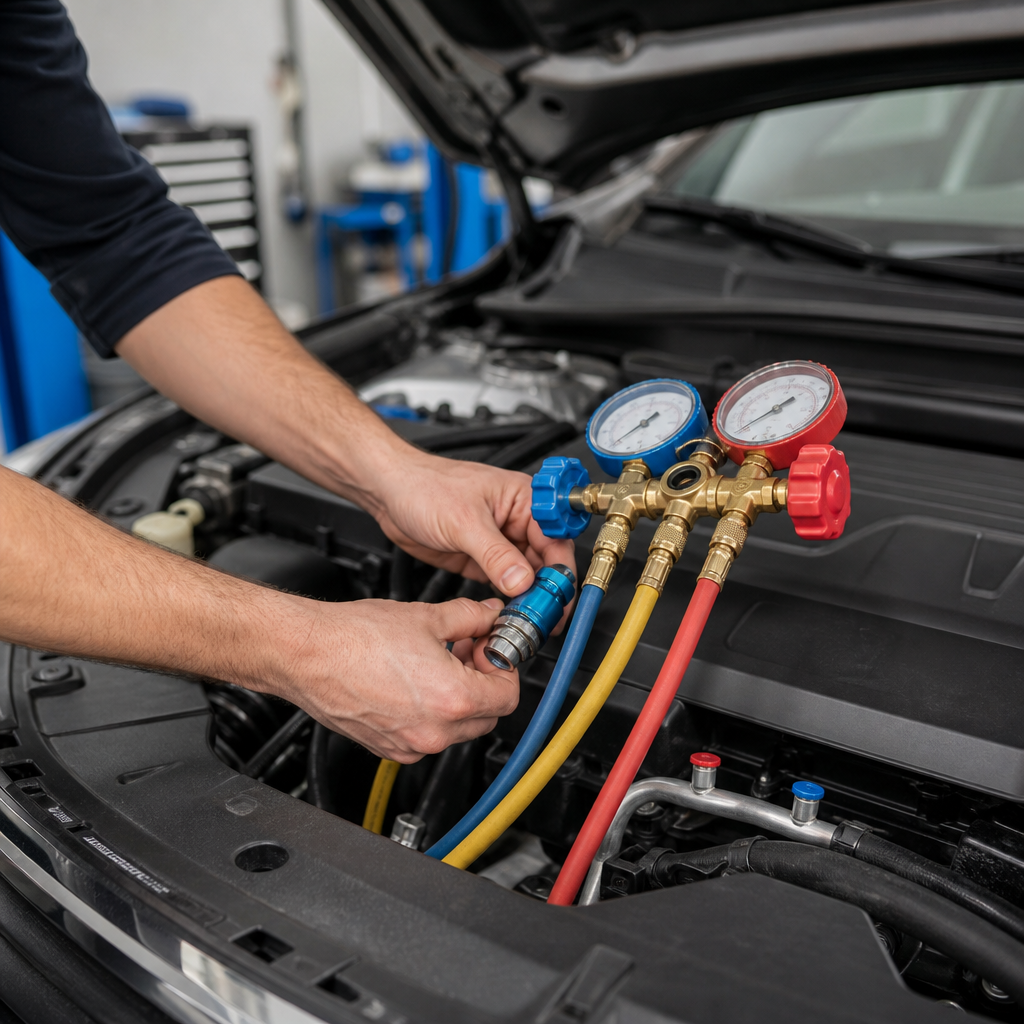
When your car’s air conditioning gives up on a hot Los Angeles afternoon, the first move for most drivers is to search “AC fix.” The problem is that there isn’t one single fix. A car’s AC system is made up of several parts that work together, and the same complaint, like warm air, can come from very different causes. Some are worth a quick look in your driveway. Others need proper equipment and a trained technician.
This guide helps you sort one from the other. We’ll go through the symptoms drivers describe most often, the simple checks worth doing first, the repairs that belong in a shop, and the questions to ask before you approve any work.
Start With the Symptom, Not the Part
Before anyone replaces a part, it helps to describe exactly what your AC is doing. Technicians use those details to narrow down the cause, so take a minute to note what you’re seeing, hearing, and smelling.
The AC Blows Warm or Only Cool Air
This is the most common complaint. Service providers commonly point to several possible causes: low refrigerant, a leak somewhere in the system, a compressor that isn’t working properly, a blocked condenser, or an electrical fault. Because so many different problems look the same from the driver’s seat, warm air usually calls for a diagnosis rather than a guess. Our guide on why a car AC isn’t blowing cold covers these possibilities in more depth.
The Air Is Cold but Weak
If the air feels cold but barely moves, the cause may be simpler. A clogged cabin air filter can restrict airflow through the vents, and on many vehicles the filter is a straightforward replacement. If a new filter doesn’t help, have a technician look at the rest of the airflow path.
Water on the Floor Inside the Car
Your AC naturally produces condensation, which is meant to drain out beneath the car. If that drain becomes blocked, water can collect inside the cabin, often showing up as a damp floor mat on the passenger side. A damp carpet is worth addressing quickly, since moisture that sits in the cabin is never good for the interior.
Odd Smells, or an AC That Works Only Sometimes
A musty smell when the AC starts up, or cooling that comes and goes, doesn’t have one standard explanation. Mention both to your technician along with when they happen: at startup, only in traffic, only on hot days. Those patterns help point to the right part of the system.
Simple Checks Before You Book
You don’t need tools for most of these, and they can save you a trip or at least give your technician better information.
- Confirm the settings. Make sure the AC button is on, the temperature is set to cold, and the fan is turned up. It sounds obvious, but it’s worth thirty seconds.
- Check your cabin air filter. Your owner’s manual shows where it is and how often to replace it. If it’s packed with dust and debris, replacing it is a reasonable first step when airflow is weak.
- Look at the front of the car. With the engine off, check whether leaves, plastic bags, or road debris are stuck behind the grille where air needs to pass.
- Write down the pattern. Does the AC work when you first start the car and fade after twenty minutes? Does it only fail in stop-and-go traffic? Details like these speed up diagnosis.
If none of these changes anything, that’s useful information too. It tells you the issue likely lives deeper in the system.
AC Repairs That Belong in a Shop
Some AC work isn’t a good fit for a driveway, even if you’re handy.
Anything involving refrigerant. Federal rules under Section 609 of the Clean Air Act require technicians who service motor vehicle air conditioners to be EPA-certified, and intentionally releasing refrigerant is prohibited. Refrigerant work needs the right equipment and the right training, which is one more reason to take it to a professional shop.
Warm air with no obvious cause. Reaching for a recharge can is tempting, but without knowing why cooling dropped, adding refrigerant is a guess. If you’ve had a recharge before and the cooling faded again, that’s a sign to ask for a proper diagnosis. We explain what that visit typically includes in our article on what to expect from a car AC diagnostic.
Compressor, condenser, and electrical problems. These parts are central to how the system works, and electrical faults can be tricky to trace. They’re best left to a technician with diagnostic equipment.
Intermittent cooling. A system that works sometimes and quits other times can have several different causes. Chasing it by swapping parts gets expensive. A methodical diagnosis is usually the faster route.
Quick Reference: What You Can Do vs. What to Book
| What you notice | A possible area to look at | Good first step |
|---|---|---|
| Cold air, weak flow | Cabin air filter or airflow path | Check or replace the filter; book a visit if no change |
| Warm air from the vents | Refrigerant, compressor, condenser, or electrical | Book a diagnosis |
| Water on the passenger floor | Blocked condensation drain | Have the drain checked soon |
| Cooling comes and goes | Several possible causes | Note when it happens, then book a diagnosis |
| Cooling faded after a past recharge | Something may still need repair | Ask for a full diagnosis, not another top-off |
Questions to Ask Before You Approve an AC Fix
A good shop will welcome these questions.
- What did you find, and how did you find it? You should hear a specific cause, not just “it needs a recharge.”
- If refrigerant was low, do you know why? Understanding the reason matters before more is added.
- Can you give me the repair estimate in writing? Parts and labor should be itemized.
- Is there a warranty on the repair? It should be clear what’s covered and for how long.
- Are there other items I should plan for? Ask what needs attention now and what can wait.
If cost is on your mind, our breakdowns of AC recharge costs in Los Angeles and overall AC repair costs can help you know what to expect before you call.
How Hyperion Auto Repair Approaches AC Problems
Hyperion Auto Repair has been family-owned since 1985, and our ASE-certified technicians work on air conditioning problems for drivers across Los Angeles, including Silver Lake, Echo Park, Los Feliz, and Koreatown. We start by figuring out what’s actually wrong, then explain it in plain language so you can decide what to do.
Every repair we do is backed by a warranty. And if you’re not sure whether your AC trouble is the tip of something bigger, ask about our free multi-point inspection. It gives you a clearer picture of your vehicle’s overall condition, not just the AC.
Frequently Asked Questions
Can I fix my car’s AC myself?
Some small jobs, like replacing a cabin air filter, are reasonable to do at home if your owner’s manual shows how. Work involving refrigerant is different, since certified technicians are required by federal rules to handle it in a professional setting.
Should I keep using the AC if it isn’t cooling well?
It’s best to have it checked rather than keep running it and hoping it improves. If you hear unusual noises or notice other changes, get it looked at sooner.
Why does my AC cool only some of the time?
Several different problems can cause intermittent cooling, so noting exactly when it happens is the most helpful thing you can do before a diagnosis.
Get Your AC Looked At
If your car’s AC isn’t cooling the way it should, contact Hyperion Auto Repair at (323) 667-3180 or stop by 1845 Hyperion Avenue, Los Angeles, CA 90027. We’ll help you find the cause and get you back to a comfortable drive.