
Auto Air Conditioning Repair for Echo Park Drivers: Complete Professional Guide 2026
When Los Angeles temperatures soar past 90°F—which happens frequently in our region—your car’s air conditioning isn’t just a comfort feature. For Echo Park drivers navigating the city’s notorious summer heat, a working AC system is essential to safe, comfortable driving. Yet many car owners put off AC repairs, assuming they’re minor issues or too expensive. The truth? Ignoring AC problems can lead to costly repairs and unsafe driving conditions.
At Hyperion Auto Repair, we’ve been helping Los Angeles drivers with AC issues for over 40 years. Our ASE-certified technicians understand that a failing AC system deserves immediate professional attention. In this guide, we’ll walk you through how AC systems work, the most common problems we see, why professional AC repair matters, and how to protect your comfort year-round.
Common AC System Problems in Los Angeles
Los Angeles drivers experience specific air conditioning challenges thanks to our intense heat and air quality. Here are the most common issues our technicians encounter:
Weak or No Cool Air
This is the most common complaint. Your AC runs, but the air coming from your vents isn’t cold. This usually indicates low refrigerant (from a leak) or a failing compressor. Many drivers mistakenly think the system just needs a “recharge,” but if refrigerant is low, there’s an underlying leak that recharging won’t fix.
Intermittent Cooling
Your AC works great on cooler days but fails on hot days, or it cycles on and off. This often points to a refrigerant leak or an electrical issue with the AC clutch. Echo Park drivers often notice this pattern intensifying during our worst heat waves.
Strange Noises: Clicking, Whining, or Grinding
Unusual sounds from your AC system signal component failure. A grinding noise often means the compressor is failing. Clicking sounds may indicate a faulty compressor clutch. Whining suggests belt or pulley problems. These aren’t issues to ignore—they’ll worsen quickly.
Foul or Musty Odors
A moldy smell from your vents indicates bacterial growth in the evaporator core or cabin air filter. While not dangerous to your AC itself, this suggests moisture buildup and potential allergenic mold.
High Pressure Warnings
Modern vehicles with diagnostic systems may alert you to high AC pressure. This can indicate a refrigerant overcharge, blockage, or failing condenser—all requiring professional diagnosis.
Understanding Your AC System: How It Actually Works
Before you can understand why AC repair is complex, you need to know how the system works. Most car owners have a misconception about air conditioning: they think it generates cold air. It doesn’t.
Your AC system’s real job is to remove heat from your cabin.
Here’s how it works:
- The Refrigerant Cycle Begins: Refrigerant (typically R134a) circulates through a closed-loop system. The system doesn’t consume refrigerant—all the refrigerant is recycled.
- The Compressor: Driven by your engine, the compressor pressurizes the refrigerant into a high-pressure gas. This is where most of the energy is used.
- The Condenser: The pressurized refrigerant flows to the condenser (located at the front of your vehicle). As air passes over it, the refrigerant cools and condenses into a liquid. The heat is expelled through the front of your car.
- The Drier: The liquid refrigerant passes through a drier, which removes any moisture or air particles. This is crucial—moisture in the system causes ice crystals and system damage.
- The Expansion Valve: This valve restricts the refrigerant flow, causing a dramatic pressure drop.
- The Evaporator: Inside your cabin, the low-pressure liquid refrigerant flows through the evaporator core. As cabin air passes over it, the refrigerant evaporates back into a gas, absorbing heat in the process. The condensation that forms drains under your vehicle (you may notice water dripping under your car in summer—this is normal).
- The Cycle Repeats: The refrigerant, now a low-pressure gas, returns to the compressor to be pressurized again.
This thermodynamic cycle is precise and complex. It’s why improper handling can damage the system and why professional repair is essential.
Why DIY AC-in-a-Can Solutions Don’t Work (And Why You Shouldn’t Try Them)
Before you visit a professional shop, you’ve probably seen the tempting cans of AC refrigerant or sealant at auto parts stores. Here’s why these quick fixes are problematic:
The Fundamental Problem: Your System Isn’t “Low” on Refrigerant—It’s Leaking
AC systems operate in a closed loop. They should never lose refrigerant unless there’s a leak. If you’re low on refrigerant, the system has a problem that topping it off won’t solve. Adding more refrigerant only delays the inevitable—the leak will continue, the system will fail again, and you’ll have wasted money.
Worse, if you use an AC-in-a-can product with sealant, you’ve potentially contaminated the system. Professional technicians now have to flush the entire system before proper repair, increasing repair costs significantly.
Environmental and Legal Consequences
California Air Resources Board (CARB) regulations are strict: releasing refrigerant into the atmosphere is illegal and carries heavy fines. According to CARB, the gas contained in a single 12-ounce container of R134a is equivalent to the CO₂ emissions from burning 150 gallons of gasoline in terms of climate impact.
DIY refrigerant work risks environmental violation fines and contributes to climate damage.
Warranty and Diagnostic Complications
Using non-approved refrigerants or sealants can void your vehicle’s warranty. Additionally, sealants make it impossible for technicians to properly diagnose the real problem. A system contaminated with sealant must be completely flushed before any real repair can begin—adding hours of labor to your bill.
Professional AC Diagnostic Process: How Experts Identify Your Problem
At Hyperion Auto Repair, every AC issue starts with a thorough diagnostic. Here’s our process:
Visual Inspection
We examine the compressor, belts, hoses, and connections for obvious damage, corrosion, or leaks. We check the condenser for dirt or debris blocking airflow. For Echo Park drivers in our humid, high-pollution area, we pay special attention to condenser cleanliness.
Pressure Testing with Manifold Gauges
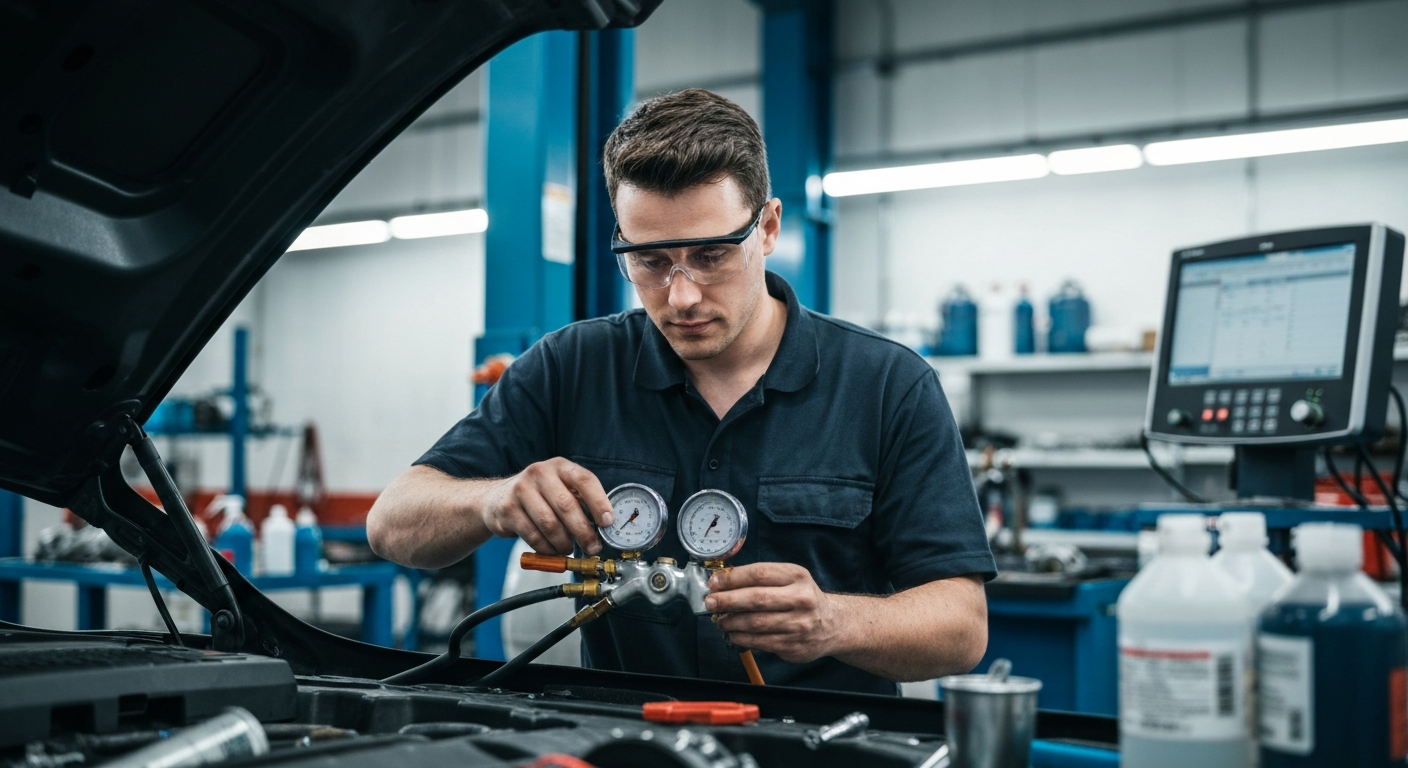
Using a manifold gauge set, we connect to both the high-side and low-side AC service ports. These gauges tell us the exact system pressures. Comparing them to your vehicle’s specifications reveals whether refrigerant is low, the system is overcharged, or something else is wrong.
UV Dye Leak Detection
If pressures indicate low refrigerant, we introduce UV dye into the system. Dye travels with the refrigerant and shows up under UV light exactly where the leak is. This pinpoints whether the leak is in a hose, connection, compressor seal, or condenser.
Electrical and Component Testing
We test the AC compressor clutch, electrical connections, and control modules. A failing clutch or bad wiring can make it seem like your refrigerant is low when the real problem is electrical.
Professional Assessment
After testing, our ASE-certified technicians explain exactly what’s wrong and recommend the most cost-effective repair path. No guessing. No unnecessary work.
Hyperion includes a free multi-point inspection with every visit—your AC system gets a thorough evaluation as part of our commitment to your vehicle’s health.
Common AC Repair Solutions and What They Cost
AC repairs range from simple to complex. Here are the most common solutions:
Refrigerant Recharge
If your system is slightly low but the leak is minor and has been sealed, a recharge adds the correct amount of refrigerant back to spec. Typical cost: $150–$300 (if no repair needed). This is NOT the same as using AC-in-a-can—we’re using professional equipment and proper refrigerant.
Leak Repair
If we find a leak, the repair depends on the source: hose replacement, connection tightening, or component replacement. Typical cost: $200–$600 (depending on location and severity).
Compressor Replacement
The compressor is the heart of your AC system. If it’s failing, it must be replaced. This involves evacuating the entire system, flushing it, replacing the compressor, adding fresh oil, and recharging. Typical cost: $800–$1,500 (parts and labor).
Condenser Repair or Replacement
If the condenser is damaged or leaking, it must be replaced. This is a more involved job. Typical cost: $600–$1,200.
Evaporator Service
If your evaporator is failing, this requires removing interior components. It’s complex work. Typical cost: $800–$2,000.
Electrical or Control Module Repairs
Sometimes the AC itself is fine, but the clutch, relay, or control module is bad. These repairs are usually simpler. Typical cost: $200–$600.
Why can’t these repairs be skipped? Driving without AC in Los Angeles heat is unsafe—it impairs focus and increases fatigue. Additionally, minor leaks become major problems. A small refrigerant leak that costs $300 to fix today becomes a $1,500 compressor replacement next summer if ignored.
Why Professional AC Repair Matters: The Safety, Legal, and Technical Reasons
You might wonder: why not just try a quick DIY fix? Here’s why professional AC repair is non-negotiable:
Refrigerant Safety and Legal Requirements
Refrigerant handling requires EPA certification. Working with pressurized refrigerant is dangerous—improper handling can cause frostbite, equipment damage, or environmental violations. California law requires proper evacuation and recovery of refrigerant before any AC work. Professionals have the equipment; DIY enthusiasts don’t.
Specialized Tools Are Required
Proper AC diagnosis and repair requires:
- Manifold gauge sets (measure pressures)
- Vacuum pumps (remove moisture)
- Refrigerant recovery and recycling machines
- UV dye leak detection equipment
- Specialized torque wrenches for connections
- Electrical testing equipment
These tools cost thousands of dollars. Professional shops invest in them because they’re essential for correct repairs.
Proper Evacuation Procedures
Before adding refrigerant, the system must be evacuated under vacuum. This removes all air and moisture. If moisture isn’t removed, it forms ice crystals inside the system, causing damage. Proper evacuation takes time and equipment—it can’t be rushed.
ASE Certification and Expertise
ASE (Automotive Service Excellence) certified technicians have passed rigorous exams on AC systems. They understand thermodynamics, system components, diagnostic procedures, and safety requirements. This expertise isn’t just about fixing your AC—it’s about doing it right the first time and doing it safely.
Hyperion Auto Repair employs ASE-certified technicians with over 40 years of experience serving Los Angeles drivers. We’re family-owned and stand behind our work with warranties on all repairs.
AC Maintenance Tips: Prevent Repairs with Regular Care
The best AC repair is the one you never need. Here’s how to maintain your system:
Run Your AC Regularly, Even in Winter
Running your AC system regularly maintains the lubrication in the compressor and keeps seals flexible. We recommend running your AC at least once a month year-round, even in winter.
Have Annual Inspections Before Summer
Schedule an inspection before the heat peaks. Small problems caught early are cheap fixes. Large problems caught in August during a heat wave are expensive emergencies.
Keep Your Condenser Clean
A dirty condenser reduces efficiency and strains the system. Have your condenser inspected and cleaned if needed—this is especially important for Echo Park drivers in our dusty climate.
Replace Cabin Air Filters Regularly
A clogged cabin air filter restricts airflow, making your AC work harder. Replace it according to your vehicle’s maintenance schedule (typically every 12,000–15,000 miles).
Watch for Early Warning Signs
If you notice weak cooling, strange noises, or odors, get an inspection immediately. Early diagnosis prevents major failures.
Include AC in Your Preventative Maintenance Routine
Think of AC maintenance as part of broader vehicle care. Properly maintaining your cooling system, transmission fluid service, and brake components keeps your entire vehicle running smoothly.
When to Seek Professional Help: Warning Signs You Can’t Ignore
Some AC issues are immediately obvious. Here’s when to seek help:
- AC won’t turn on: Immediate issue—could be electrical or refrigerant leak
- AC blows warm air: System needs diagnosis—don’t wait for summer peak
- Unusual noises from AC: Components are failing—every cycle worsens damage
- Strong odors: Mold or contamination present—health concern
- AC leaking onto your floor: Usually just condensation (normal), but if you see oily residue, refrigerant may be leaking
- Warning lights on dashboard: Your vehicle is telling you to get help
Don’t assume AC problems will resolve on their own. They won’t. Small issues become expensive failures.
Conclusion: Your Air Conditioning Deserves Professional Care
Los Angeles summers are harsh on air conditioning systems. Echo Park drivers, like all our Los Angeles customers, depend on reliable AC to stay safe and comfortable on the road. AC repair isn’t a luxury—it’s essential maintenance that impacts your safety, vehicle longevity, and comfort.
DIY solutions and quick fixes won’t cut it. Your AC system is complex, modern vehicles demand professional care, and California regulations make proper repair a legal matter.
At Hyperion Auto Repair, we’ve served Los Angeles drivers for over 40 years. Our ASE-certified technicians provide expert diagnostic and repair services with:
- Free multi-point inspections on every visit
- Honest, transparent assessments
- Warranties on all AC repairs
- Environmentally compliant work
- Fair pricing with no surprises
Don’t let another hot Los Angeles summer go without reliable AC. Schedule your free inspection today.
Hyperion Auto Repair
1845 Hyperion Avenue
Los Angeles, CA 90027
(323) 667-3180
Open Monday–Friday, 8 AM–6 PM | Saturday, 9 AM–4 PM
Professional Auto Care You Can Trust